

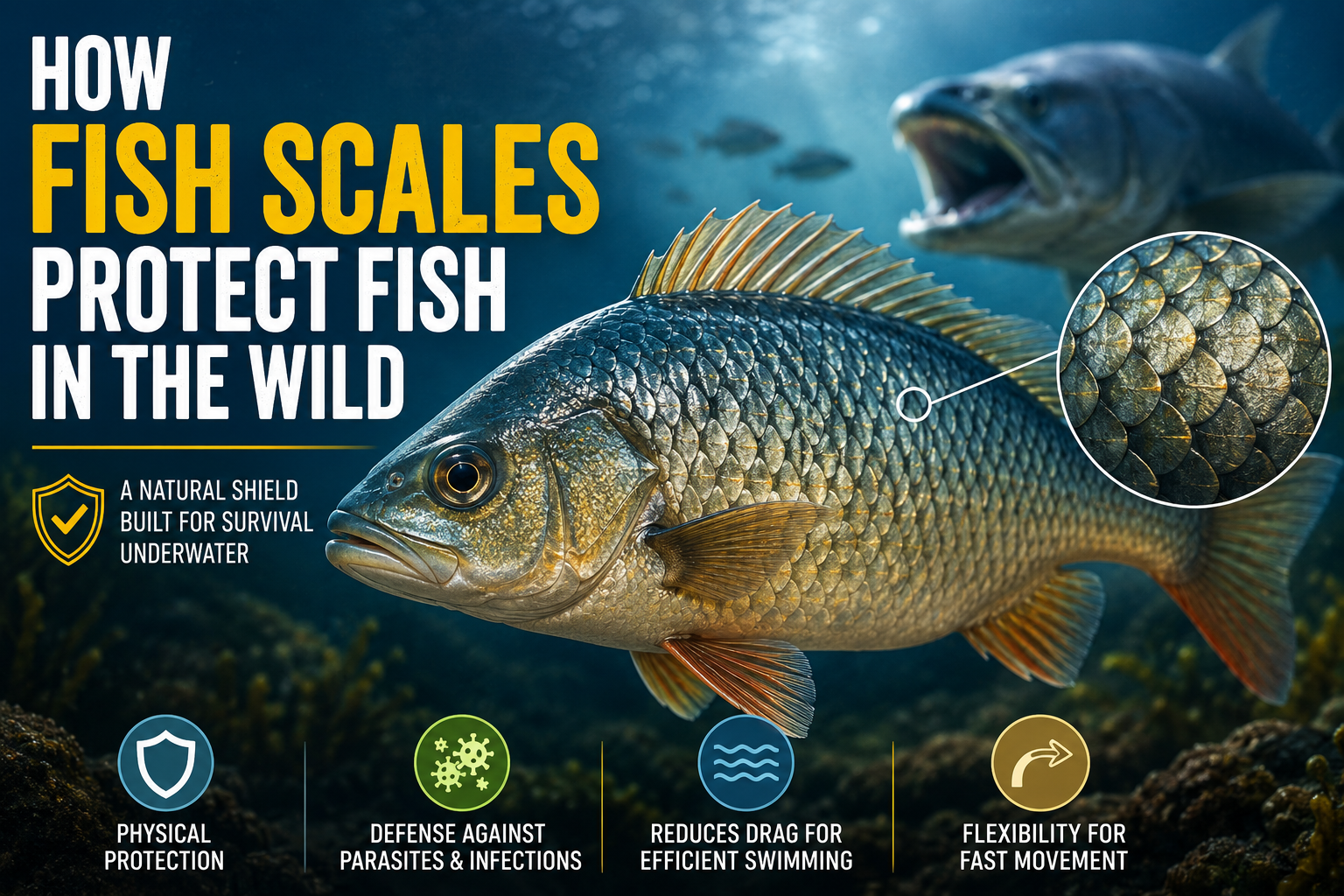
A fish may look smooth and delicate as it moves through the water, but its body is built to handle a surprisingly rough environment. Sharp rocks, broken shells, coral branches, parasites, aggressive fish, and hungry predators are all part of daily life underwater.
Fish scales play a major role in helping fish survive these challenges. They form a lightweight protective covering that reduces injuries without limiting movement. Unlike a hard shell, scales bend with the fish’s body, allowing it to swim, turn, hunt, and escape danger without carrying heavy armor.
The scales are only one part of this defense system. Fish skin, mucus, body shape, speed, camouflage, and behavior all work together. Still, the layered design of fish scales gives many species an effective balance between protection and flexibility.
How Fish Scales Protect Fish in the Wild
Fish scales act like flexible natural armor. Most scales overlap, with part of each scale covering the one behind it. This arrangement is similar to roof tiles, although fish scales are much thinner and more flexible.
When a fish brushes against a rock or is bitten by another animal, the overlapping scales can help spread the force across a wider area. Instead of all the pressure reaching one small point on the skin, some of it is absorbed by the surrounding scales.
This protective layer helps fish deal with many common hazards, including:
- Sharp rocks and rough riverbeds
- Coral and underwater plants
- Broken shells and submerged branches
- Bites from other fish
- Attacks from larger predators
- Sand, debris, and strong currents
Scales cannot prevent every wound, especially during a serious predator attack. However, they may reduce the depth of a scratch, bite, or puncture. Even a small reduction in damage can give a fish a better chance of escaping and recovering.
A Protective Layer That Still Allows Movement
A rigid outer shell would make swimming difficult. Fish need to bend their bodies from side to side, make sudden turns, and move through narrow spaces. Their scales must provide protection without getting in the way.
Many fish scales develop within small pockets in the skin. The exposed sections overlap while the deeper portions remain attached to the body. This structure keeps the scales secure but allows them to move slightly as the fish bends.
The result is a protective surface that remains flexible. A reef fish can weave between coral branches, a river fish can navigate around stones, and a fast-moving predator can chase prey without losing much freedom of movement.
The size and thickness of the scales vary between species. Fish that need stronger physical protection may have heavier scales, while fast swimmers often have thinner, smoother coverings that support efficient movement.
The Slime Coat Provides Extra Protection
Fish scales do not work alone. Most fish are covered by a thin layer of mucus commonly known as the slime coat. It may not be visible from a distance, but it is one of the fish’s most important defenses.
The slime coat covers both the scales and exposed skin. It creates a slippery barrier between the fish’s body and the surrounding water, which may contain bacteria, fungi, parasites, and irritating particles.
Helping Defend Against Parasites and Infection
Wild water is full of microscopic life. Some organisms are harmless, while others can attach to fish and cause disease. A healthy slime coat makes it harder for certain parasites and harmful microorganisms to reach the skin.
The mucus layer may help by:
- Making it more difficult for parasites to attach
- Trapping or blocking some harmful organisms
- Reducing irritation from sand and debris
- Protecting sensitive tissue beneath the scales
- Supporting the healing of minor surface injuries
When scales are damaged, the slime coat around the injury may also be disturbed. This leaves the exposed area more vulnerable to bacterial infections, fungal growth, and parasites.
That is one reason missing scales can become more serious than they first appear. The fish has not only lost part of its physical armor but may also have a weaker mucus barrier in the damaged area.
Making Fish Harder to Grab
A slippery surface can also help during a predator attack. When another animal bites or grabs a fish, the mucus-covered scales may make it harder to maintain a firm hold.
This does not mean the slime coat makes a fish impossible to catch. A powerful predator can still cause severe damage. However, the fish may have a better chance of twisting free, especially if the predator only has a loose grip.
In the wild, even a small advantage can be the difference between escape and capture.
Fish Scales Support Efficient Swimming
Protection is not the only benefit fish scales provide. Their smooth, organized surface can also help water flow across the fish’s body.
Swimming requires energy, and water creates resistance. Fish with streamlined bodies, neatly arranged scales, and healthy mucus coatings can move through the water more efficiently than they would with a rough, uneven surface.
Reducing Drag in the Water
Drag is the resistance a fish experiences as it swims. The shape of the body has the greatest influence on drag, but scales and mucus also contribute to the way water moves across the skin.
Smooth scales can reduce unnecessary turbulence around the body. The slime coat adds another slick layer, helping water pass more easily over the fish.
Using less energy while swimming is valuable because fish need that energy for many survival activities, such as:
- Escaping predators
- Catching prey
- Migrating between habitats
- Finding a mate
- Swimming against currents
- Searching for food and shelter
Scales alone do not determine how fast a fish can swim. Muscle strength, fin shape, body design, and behavior are also important. Still, a smooth and flexible outer surface supports more efficient movement.
Allowing Quick Turns and Sudden Escapes
Fish often need to change direction with little warning. A predator may appear from behind a rock, or prey may suddenly move in another direction.
Because fish scales overlap rather than forming one solid plate, they can shift slightly as the body bends. This allows the fish to turn sharply without exposing large areas of skin.
Small schooling fish rely on this flexibility when an entire group changes direction at once. Reef fish use it to slip into narrow hiding spots, while river fish need it to move through uneven currents and around obstacles.
Different Types of Fish Scales
Not all fish have the same kind of scales. Scale shape, thickness, texture, and arrangement differ depending on the fish’s evolutionary history and environment.
Scientists generally describe four major types of fish scales: placoid, ganoid, cycloid, and ctenoid scales.
Placoid Scales
Placoid scales are found on sharks and rays. They are small, hard structures that resemble tiny teeth. Each one points toward the tail, creating a surface that feels smooth in one direction and rough in the other.
These scales are also called dermal denticles. They help protect the skin while influencing the way water moves across the body. This can support efficient swimming, particularly in fast-moving sharks.
Placoid scales are quite different from the thin, rounded scales seen on many bony fish. Their tooth-like structure provides a tough outer surface suited to active predators.
Ganoid Scales
Ganoid scales are thick, hard, and often diamond-shaped. They can be found on fish such as gars and bichirs.
These scales fit closely together and create a strong protective covering. Compared with softer overlapping scales, ganoid scales provide heavier armor but may offer less flexibility.
This type of protection is useful for fish that benefit from a tougher outer layer. The hard surface can help reduce damage from bites, rough objects, and other physical hazards.
Cycloid Scales
Cycloid scales are thin, rounded, and smooth along the outer edge. They are found on many familiar fish, including salmon, carp, and herring.
Their overlapping arrangement allows the body to bend easily. This makes cycloid scales well suited to fish that depend on flexible movement and steady swimming.
Because they are thin, they may not feel like heavy armor. However, several layers overlap across the body, creating a covering that protects the skin while remaining lightweight.
Ctenoid Scales
Ctenoid scales are similar to cycloid scales but have tiny comb-like projections along their exposed edges. They are common among spiny-rayed fish, including perch and many reef species.
The rough edge gives ctenoid scales a slightly different texture. Like cycloid scales, they overlap and provide protection without greatly restricting movement.
The type of scales a fish has often reflects how it lives. A heavily armored fish faces different challenges from a fast swimmer that depends on speed and agility.
Why Some Fish Have Few or No Visible Scales
Although scales are useful, not every fish relies on them in the same way. Some species have extremely small scales, scales buried beneath the skin, or no obvious scales at all.
Catfish, for example, generally lack traditional scales. Many have thick skin and a heavy mucus coating instead. Eels may have tiny scales hidden within their skin, making their bodies appear completely smooth.
Other fish use alternative forms of protection, such as:
- Thick or tough skin
- Bony plates
- Sharp spines
- Heavy mucus production
- Camouflage
- Venomous structures
- Fast escape behavior
- Hiding in rocks, sand, or mud
These differences show how strongly habitat shapes a fish’s body. A fish living over a soft, muddy bottom may not need the same type of armor as one that regularly swims among sharp coral.
Protection in the wild is rarely based on a single feature. Fish survive through a combination of physical defenses, movement, color, senses, and behavior.
Can Fish Scales Stop Predator Bites?
Fish scales can reduce damage from some attacks, but they are not an unbreakable shield. Large teeth, strong jaws, claws, and beaks can still pierce or crush the body.
The main benefit of scales is that they add resistance between the predator and the fish’s softer tissue. Overlapping scales may make it harder for teeth to penetrate immediately, particularly during a glancing bite.
Sometimes a fish escapes after losing only a few scales. The missing scales may represent a relatively minor injury compared with what could have happened if the predator had gained a stronger grip.
Some scales may also detach under pressure. While losing part of the protective covering is not ideal, it can help the fish pull away from an attacker in certain situations.
What Happens When a Fish Loses Scales?
Missing scales expose the delicate skin underneath. The area may become red, irritated, or sensitive, and the fish may face a greater risk of infection.
Damaged areas can be vulnerable to:
- Harmful bacteria
- Fungal growth
- External parasites
- Additional physical injuries
- Irritation from poor water quality
- Stress and slower healing
Many fish can regrow lost scales if the deeper skin tissue has not been severely damaged. New scales may initially look smaller, thinner, or different in color. Over time, they can become less noticeable as they continue to develop.
Recovery depends on the species, the fish’s overall health, water conditions, food availability, and the seriousness of the wound.
What Fish Scales Reveal About a Fish’s Life
Fish scales are not only useful to the fish. They can also provide scientists with information about age, growth, habitat, and survival.
Certain scales develop visible growth patterns as the fish gets older. These patterns can sometimes be examined in a way that is similar to studying growth rings in trees.
Researchers may use fish scales to investigate:
- Approximate age
- Seasonal growth changes
- Periods of limited food
- Migration patterns
- Habitat conditions
- Previous physical injuries
- The health of a fish population
A period of slow growth may leave a different pattern than a season when food was plentiful. Scale condition can also reveal whether a fish has experienced repeated injuries, disease, or environmental stress.
Not every fish species can be aged accurately through scales, and scientists may use other structures when necessary. However, scale samples remain a valuable research tool because they can often be collected without seriously harming the fish.
Signs That the Protective Scale Layer Is Damaged
Minor scale loss may heal without causing lasting problems, but larger or repeated injuries deserve attention. In wild fish, damage may result from predators, rough habitats, fishing gear, parasites, or disease.
Common signs of damaged fish scales include:
- Bare patches on the body
- Red or inflamed skin
- Open sores
- White or fuzzy growth
- Excessive mucus
- Scales sticking outward
- Rubbing against rocks or other surfaces
- Weak or unusual swimming
Raised scales across much of the body are different from a few scales lifted by a local injury. When scales stick out in a pinecone-like pattern, it may be connected to a serious internal health problem.
A fish with healthy scales usually has a smooth, even appearance. The protective surface follows the shape of the body, while the mucus coating keeps it slick.
Fish scales are most effective when they work alongside healthy skin, a strong slime coat, fast reactions, and natural survival behavior. Together, these features help fish handle the constant challenges of life underwater while remaining flexible enough to swim freely.