

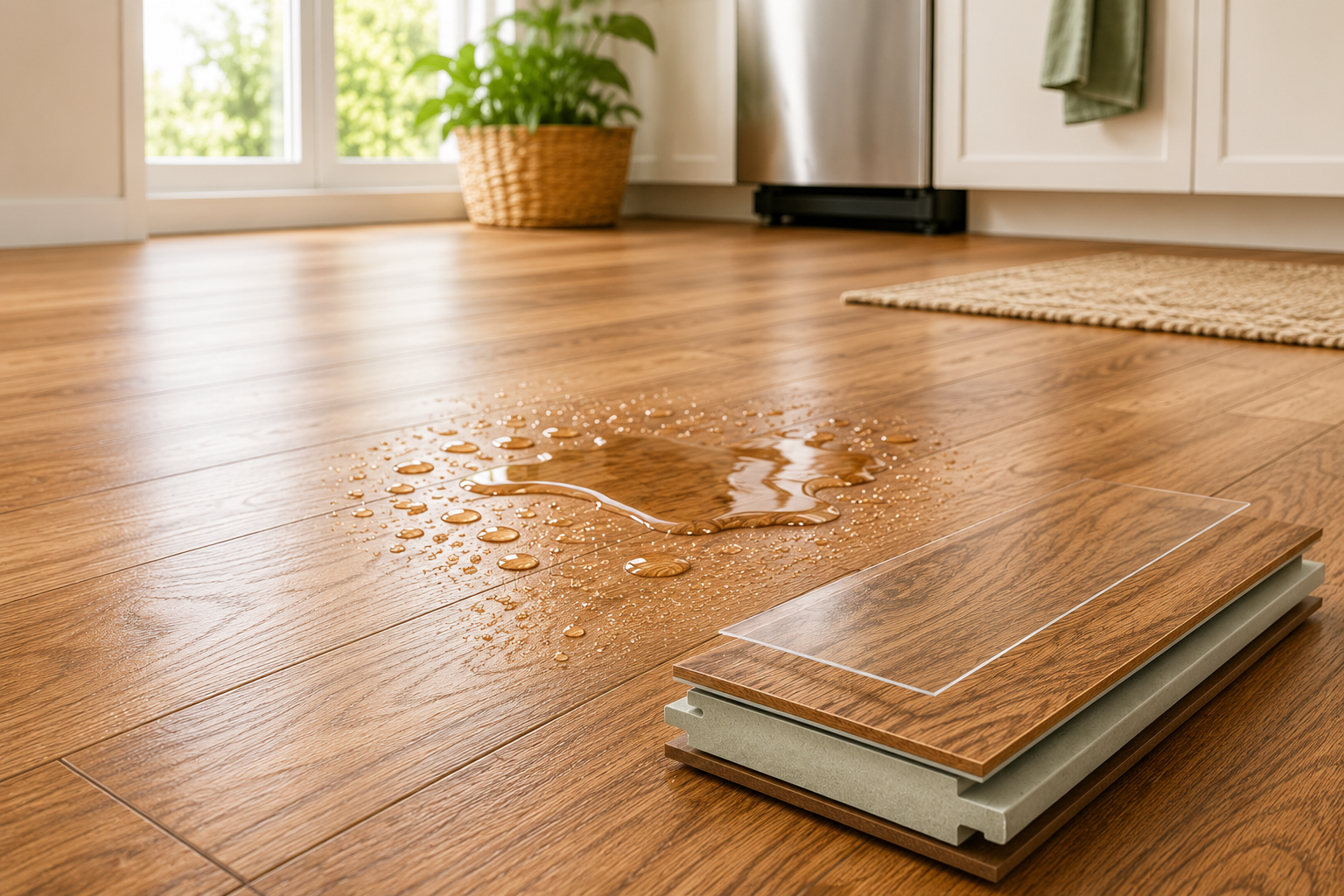
A spilled drink, a pet accident, or water dripping from the kitchen sink can quickly become a problem on traditional laminate flooring. Once moisture reaches the inner core, the planks may swell, warp, or lift at the edges. Waterproof laminate wood flooring is designed to reduce that risk while still offering the warm, natural appearance of real hardwood.
However, no single ingredient makes laminate flooring waterproof. Its moisture protection comes from several features working together, including a dense core, a protective wear layer, sealed plank edges, a tight click-lock system, and correct installation.
Understanding these features can help you choose the right flooring for kitchens, bathrooms, basements, entryways, and other areas where spills are likely.
What Makes Laminate Wood Floor Waterproof?
Waterproof laminate wood flooring is built as a layered moisture-control system. The surface prevents water from soaking in from above, while sealed edges and tightly connected joints help stop liquid from reaching the inner core.
The main features that make laminate flooring waterproof include:
- A moisture-resistant core
- A durable protective wear layer
- Water-repellent surface treatments
- Factory-sealed plank edges
- A tight click-lock installation system
- Properly sealed room perimeters
- Compatible moisture-resistant underlayment
- Careful installation over a dry, level subfloor
The word “waterproof” should still be viewed realistically. Most waterproof laminate flooring can handle everyday spills, wet shoes, damp mopping, and limited standing water. It is not necessarily designed to survive flooding, burst pipes, or water trapped underneath the planks for several days.
The exact level of protection depends on the product, how it is installed, and what the manufacturer’s warranty covers.
How Waterproof Laminate Flooring Is Constructed
Laminate flooring may look like solid wood, but each plank is made from several layers. Every layer has a different job, and together they create a floor that is attractive, durable, and resistant to moisture.
The Protective Wear Layer
The wear layer is the clear top surface of the plank. It protects the decorative wood-look design underneath and provides resistance against spills, stains, scratches, fading, and everyday foot traffic.
When water lands on the floor, this layer helps keep it on the surface long enough for it to be cleaned. It also prevents minor spills from soaking directly into the printed design layer.
A strong wear layer can help protect against:
- Food and drink stains
- Pet claws
- Furniture scratches
- Muddy shoes
- Light cleaning moisture
- Scuffs in busy areas
Although the wear layer is important, it cannot make the entire floor waterproof by itself. Water may still enter through damaged seams, exposed edges, or unsealed gaps around walls.
The Decorative Wood-Look Layer
Under the wear layer is a high-resolution printed design that gives laminate its wood-like appearance. It may recreate oak, walnut, maple, hickory, or other natural wood styles.
This layer is mainly decorative rather than structural. If moisture reaches it, the image may fade, bubble, or separate from the plank. That is why the surface coating and sealed joints are so important.
The Moisture-Resistant Core
The core is the most important part of waterproof laminate flooring. Traditional laminate often uses a wood-fiber core that can absorb water. When that happens, the plank may swell and lose its original shape.
Waterproof laminate typically uses a denser, specially treated core designed to slow moisture absorption. Depending on the manufacturer, it may be made from water-resistant high-density fiberboard or another engineered material.
A quality moisture-resistant core helps reduce the risk of:
- Swollen plank edges
- Raised seams
- Buckling
- Warping
- Soft spots
- Permanent changes in plank shape
Not every laminate core offers the same level of protection. Before purchasing, check how long the product is rated to resist standing water and whether that protection is included in the warranty.
The Stabilizing Backing Layer
The bottom layer supports the plank and helps it remain balanced. It reduces movement caused by changes in temperature and humidity and can provide some protection against moisture rising from below.
Some waterproof laminate products also come with attached underlayment. This can add cushioning, reduce sound, and simplify installation, although additional moisture protection may still be required over concrete.
How the Click-Lock System Helps Keep Water Out
Waterproof laminate flooring relies heavily on the way each plank connects to the next. Most modern laminate uses a click-lock system that allows the edges to fit tightly together without nails or glue.
When installed properly, these connections create narrow seams that make it difficult for water to pass through.
Some advanced locking systems include:
- Angled locking edges
- Overlapping joint profiles
- Compression-based connections
- Wax-treated grooves
- Water-repellent seam coatings
The tighter the connection, the less opportunity water has to reach the core.
Small gaps can still develop when flooring is installed over an uneven subfloor, locking edges are damaged, or planks are not fully connected. Water may enter through these gaps and become trapped underneath the floor.
Moisture below the planks is especially difficult to detect. Over time, it can lead to musty odors, mold growth, damaged underlayment, or problems with the subfloor.
Why Sealed Plank Edges Matter
The edges of a laminate plank are more vulnerable than the top surface because they are closer to the inner core. Manufacturers may apply wax, resin, or another water-repellent treatment to these areas to slow moisture absorption.
Factory-sealed edges are particularly useful in rooms where spills happen often, such as kitchens, dining areas, entryways, and homes with children or pets.
Some products also use hydrophobic surface treatments. A hydrophobic coating causes liquid to form beads on top of the floor rather than spreading and soaking in immediately. This gives you more time to wipe up the spill.
Textured laminate flooring may require extra attention. Deep wood-grain patterns look realistic, but they can hold small amounts of water or cleaning solution. Wiping the surface dry after mopping helps prevent moisture from collecting in those grooves.
Waterproof Laminate vs Water-Resistant Laminate
Waterproof and water-resistant laminate flooring are often discussed as though they are the same product, but the level of protection can be different.
Water-resistant laminate can usually handle minor moisture when it is removed quickly. This may include damp footprints, small drink spills, light splashes, and cleaning with a slightly damp mop.
Waterproof laminate is generally designed to tolerate standing water for a specific period. Some products may offer protection for several hours, while others advertise longer surface-water resistance.
Rather than relying only on the product label, review the technical information carefully. Look for details such as:
- The maximum standing-water exposure time
- Whether the flooring is approved for bathrooms
- Underlayment or vapor-barrier requirements
- Perimeter-sealing instructions
- Residential and commercial warranty terms
- Cleaning restrictions
- Exclusions for flooding and appliance leaks
A waterproof label does not always mean the manufacturer will cover every type of water damage. Major leaks, sewage backups, flooding, and moisture entering from below are commonly excluded.
Proper Installation Is Essential
Even the best waterproof laminate flooring can fail if it is installed incorrectly. Loose joints, uneven surfaces, and unsealed room edges can create openings where water can enter.
Preparing the Subfloor
The subfloor should be clean, dry, smooth, and level before installation begins. High or low areas can place pressure on the locking system, eventually causing the planks to separate.
Preparation may include:
- Repairing cracks and low spots
- Removing dust and loose debris
- Testing the subfloor for moisture
- Allowing new concrete to cure
- Removing unstable flooring materials
- Checking that the surface is level
A concrete floor may look dry while still releasing water vapor. Moisture testing is particularly important in basements, ground-floor rooms, and newly constructed properties.
Choosing the Correct Underlayment
Underlayment can reduce noise, improve comfort, and help control moisture from below. Concrete subfloors often require a vapor barrier unless the chosen flooring already includes approved moisture protection.
Laminate with attached padding may not need an additional cushioning layer. Adding too much underlayment can make the floor feel unstable and may place stress on the click-lock joints.
Always follow the flooring manufacturer’s instructions. Using the wrong underlayment can affect waterproof performance and may void the warranty.
Sealing the Perimeter
Water can enter around walls, doorways, cabinets, pipes, bathtubs, toilets, and appliances. Some waterproof laminate installations require a flexible silicone sealant in these areas.
The sealant should prevent moisture from reaching the edges while still allowing the floating floor to expand and contract.
Laminate usually requires a small expansion gap around the room. Without enough space, the planks may buckle as temperature and humidity change. If the gap is left exposed or sealed incorrectly, however, it can become an entry point for water.
Where Waterproof Laminate Flooring Works Best
Waterproof laminate wood flooring is a practical option for rooms where you want the look of hardwood without the same sensitivity to everyday spills.
Kitchens
Kitchens are one of the most popular places to install waterproof laminate flooring. It handles routine messes well and is generally easier to clean than natural hardwood.
Pay close attention to areas around:
- The sink
- The dishwasher
- The refrigerator
- Ice makers
- Pet bowls
- Exterior doors
Waterproof flooring can protect against ordinary spills, but it should not be used as a substitute for checking appliances and plumbing for slow leaks.
Bathrooms
Some waterproof laminate products are approved for bathroom use, but others are not. Check the installation guide before selecting flooring for a full bathroom.
Bathroom installations may require perimeter sealing, moisture-resistant trim, and special attention around toilets, bathtubs, showers, and plumbing fixtures.
Using bath mats, running a ventilation fan, and wiping up standing water can also help protect the floor.
Basements
Waterproof laminate can work well in a dry, climate-controlled basement. The concrete should be tested for moisture, and an approved vapor barrier may be necessary.
It is not the best choice for a basement with regular flooding, drainage issues, or ongoing dampness. Waterproof laminate can resist surface spills, but it cannot solve an existing moisture problem in the building.
Entryways, Laundry Rooms, and Pet Areas
Wet shoes, umbrellas, pet accidents, food bowls, and washing-machine splashes make these spaces good candidates for waterproof laminate.
Protective trays beneath pet bowls and appliances can provide an extra layer of protection, particularly near plank seams and room edges.
How Long Can Waterproof Laminate Handle Standing Water?
Standing-water resistance varies between brands and product lines. One floor may be designed to resist water for a few hours, while another may offer longer protection under specific conditions.
Performance depends on several factors:
- The density of the core
- The strength of the locking system
- The condition of the seams
- The quality of the edge sealing
- The amount of water
- The length of exposure
- Whether water reaches the room perimeter
- Whether moisture gets underneath the planks
Even when the flooring is marketed as waterproof, spills should be cleaned as soon as possible. The longer water remains on the floor, the more likely it is to find a weak seam, damaged edge, or unsealed gap.
Signs of Water Damage in Laminate Flooring
Water damage is not always immediately visible. Moisture can remain beneath the surface after the top of the floor appears dry.
Watch for warning signs such as:
- Swollen or raised plank edges
- Bubbling under the surface
- New gaps between boards
- Darkened seams
- Soft areas underfoot
- Clicking sounds when walking
- Musty odors
- Mold near baseboards
- Water appearing between seams when pressure is applied
A damaged plank should be inspected promptly. Replacing one affected area is usually easier than dealing with moisture that has spread across the room.
How to Care for Waterproof Laminate Flooring
Waterproof laminate is easy to maintain, but it still benefits from sensible cleaning habits.
Use a slightly damp mop rather than soaking the floor. Excess water is unnecessary and may work its way into small openings over time. Choose a cleaning product made specifically for laminate and avoid abrasive chemicals that could damage the protective surface.
Steam cleaning should only be used when the manufacturer allows it. Steam combines heat with pressurized moisture, which may enter the joints and affect the internal layers.
A few simple habits can help extend the life of the floor:
- Blot spills immediately
- Dry the seams after cleaning
- Place mats near exterior doors
- Use rugs near sinks
- Put trays under pet water bowls
- Inspect dishwasher and washing-machine hoses
- Keep indoor humidity at a stable level
- Repair damaged perimeter sealant
- Replace chipped or broken planks
Waterproof does not mean maintenance-free. Regular care helps preserve both the appearance of the floor and its moisture protection.
What to Look for When Buying Waterproof Laminate Flooring
Appearance matters, but the construction and warranty deserve just as much attention.
Look for a product with:
- A dense, moisture-resistant core
- Sealed or wax-treated edges
- A reliable click-lock system
- A scratch- and stain-resistant wear layer
- Clear standing-water protection
- Approval for the intended room
- Suitable underlayment options
- Detailed installation instructions
- Strong residential warranty coverage
The Abrasion Class, or AC rating, can also help you judge how well the flooring handles traffic and wear. The AC rating does not measure waterproofing, but it is useful when choosing flooring for busy households, rental properties, hallways, or commercial spaces.
Read the warranty exclusions carefully. Coverage may be denied when damage is caused by improper installation, unapproved cleaning products, flooding, plumbing failures, missing perimeter sealant, excessive humidity, or moisture rising from the subfloor.
Common Misunderstandings About Waterproof Laminate
One of the biggest misunderstandings is that waterproof laminate is completely flood-proof. In most cases, it is designed for normal household moisture rather than continuous submersion.
Another common mistake is focusing only on the top surface. Water can bypass the wear layer by entering through open joints, damaged corners, floor vents, wall gaps, or unsealed plumbing areas.
Waterproof laminate is also different from luxury vinyl plank flooring. Laminate commonly contains a wood-based core, while many vinyl floors use a synthetic core that does not absorb water in the same way.
That does not automatically make one flooring type better than the other. Laminate often provides a more realistic wood texture and a firm feel underfoot, while vinyl may offer advantages in rooms with greater moisture exposure.
Is Waterproof Laminate Wood Flooring Worth It?
Waterproof laminate flooring can be a smart choice for households that want the appearance of natural wood with better protection against daily messes.
It is especially useful for:
- Families with young children
- Homes with dogs or cats
- Kitchens and dining areas
- Busy entryways
- Rental properties
- Homeowners working with a limited budget
- Rooms where minor spills are common
The best results come from choosing a product suited to the room, preparing the subfloor correctly, sealing vulnerable areas, and following the manufacturer’s installation requirements.
A well-made waterproof laminate floor can resist spills, wet footwear, pet accidents, and routine cleaning while maintaining its wood-look finish. It still needs prompt cleanup and proper care, but its layered construction offers far more moisture protection than traditional laminate flooring.