

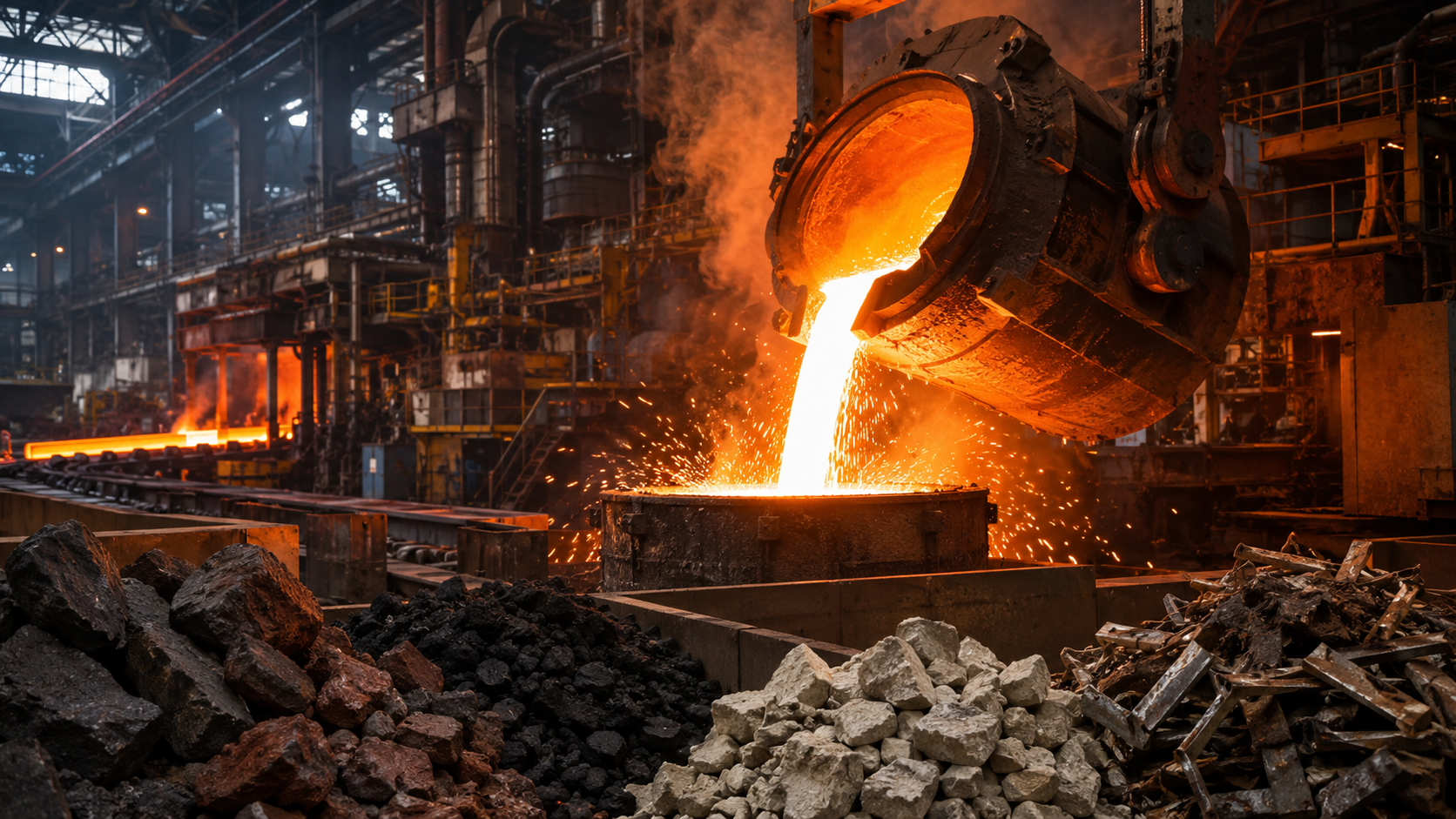
Steel is part of almost everything around us. It supports buildings, strengthens bridges, forms the bodies of cars, and appears in tools, appliances, pipelines, trains, and even food packaging. Despite being so common, steel does not come out of the ground ready to use.
The process begins with materials such as iron ore, coal, limestone, and recycled steel scrap. These ingredients are prepared, heated, melted, refined, and shaped before they become finished steel products. The exact method depends on the type of steel being made, but most production follows either the traditional blast furnace route or the electric arc furnace process.
How Do You Make Steel From Raw Materials?
Steel is made from raw materials by extracting iron from iron ore, removing unwanted elements, and carefully controlling the amount of carbon in the metal. Other alloying elements may also be added to create specific properties such as strength, hardness, heat resistance, or protection against corrosion.
In a traditional steel mill, iron ore, coke, and limestone are heated inside a blast furnace to produce molten iron. That iron contains too much carbon to be used as steel, so it is transferred to another furnace where oxygen removes the excess carbon and impurities.
Another common method uses an electric arc furnace to melt recycled steel scrap. Once the chemical composition is correct, the molten steel is cast into solid shapes, rolled into products such as sheets or beams, and treated to achieve the required strength and finish.
The main stages include:
- Preparing the raw materials
- Producing or melting iron
- Removing impurities
- Adjusting the carbon content
- Adding alloying elements
- Casting the molten steel
- Rolling and shaping it
- Cooling, finishing, and testing the final product
What Raw Materials Are Used to Make Steel?
Steel production depends on several raw materials, and each one has a specific job.
Iron Ore
Iron ore is the main source of iron in traditional steelmaking. It is mined from the earth and usually contains iron mixed with rock, oxygen, and other materials.
Hematite and magnetite are two commonly used iron-bearing minerals. Before the ore can enter a furnace, it must be crushed, cleaned, and concentrated to increase its iron content.
Coal and Coke
Coal is not normally added directly to a blast furnace. It is first heated in special ovens without oxygen. This process removes moisture, gases, and other substances, leaving behind a hard, carbon-rich material called coke.
Coke performs two important jobs. It provides the intense heat needed inside the blast furnace, and it helps remove oxygen from the iron ore.
Limestone
Limestone helps separate unwanted materials from the molten iron. When heated, it reacts with impurities such as silica and forms a lighter material called slag.
Because slag floats above the molten iron, it can be removed separately.
Recycled Steel Scrap
Recycled steel scrap comes from old vehicles, buildings, machinery, appliances, manufacturing waste, and other discarded products.
Scrap metal is especially important in electric arc furnace steelmaking, although it can also be added during basic oxygen steelmaking. Using recycled steel reduces the need for newly mined raw materials and makes better use of existing metal.
Alloying Elements
Steelmakers may add small amounts of other elements to change the performance of the steel. Common examples include:
- Chromium for corrosion resistance
- Nickel for toughness and strength
- Manganese for hardness
- Molybdenum for heat resistance
- Vanadium for added strength
- Tungsten for wear resistance
- Silicon for strength and electrical properties
The exact mixture depends on how the finished steel will be used.
How Are the Raw Materials Prepared?
Raw materials need to be processed before they can enter a furnace. Proper preparation helps the steelmaking process run more efficiently and produces more consistent results.
Preparing Iron Ore
After mining, iron ore is crushed into smaller pieces. Waste rock and other unwanted materials are removed, and the iron content is concentrated.
Fine iron ore particles may then be formed into pellets or combined into a larger material known as sinter. These shapes allow hot gases to move more easily through the blast furnace.
Turning Coal Into Coke
Coal is heated in coke ovens at high temperatures without enough oxygen for it to burn. Volatile materials are driven off, leaving a strong form of carbon.
The finished coke must be hard enough to support the weight of the other materials inside the blast furnace while still allowing gases to move upward.
Sorting Scrap Metal
Recycled steel scrap is sorted according to its composition and quality. Unwanted materials such as plastic, rubber, dirt, and non-ferrous metals are removed.
Large pieces may be cut, shredded, or compressed so they can be loaded into a furnace more easily.
How Is Iron Turned Into Molten Metal?
One of the best-known ways to produce iron is through a blast furnace. This is a tall, heavily insulated structure designed to operate continuously at extremely high temperatures.
Iron ore, coke, and limestone are loaded through the top of the furnace. At the same time, heated air is blown in near the bottom.
What Happens Inside a Blast Furnace?
As the materials move downward, the temperature rises. Coke reacts with the hot air and burns, creating both heat and carbon monoxide.
The carbon monoxide travels upward and reacts with the iron ore. This removes oxygen from the ore, leaving behind iron.
As the iron moves lower in the furnace, it melts and collects at the bottom. The limestone reacts with impurities and forms molten slag, which floats above the heavier iron.
The molten iron and slag are drained through separate openings.
What Is Pig Iron?
The iron produced by a blast furnace is often called pig iron or hot metal. It contains a high amount of carbon, along with traces of silicon, sulfur, phosphorus, and other elements.
Pig iron is too brittle for most practical uses. It must be refined before it can become steel.
How Is Molten Iron Converted Into Steel?
Molten iron becomes steel when its carbon level and chemical composition are brought under control.
One of the most widely used methods is basic oxygen steelmaking.
Basic Oxygen Steelmaking
In this process, molten iron is poured into a large, heat-resistant vessel known as a basic oxygen furnace. Recycled steel scrap may also be added.
A water-cooled lance blows high-purity oxygen onto the molten metal at high speed. The oxygen reacts with excess carbon and other unwanted elements.
These reactions produce heat and help remove materials such as:
- Carbon
- Silicon
- Phosphorus
- Manganese
- Sulfur-related impurities
Some impurities become gases, while others enter the slag layer and are removed.
The process can turn a large quantity of molten iron into steel in a relatively short period.
Why Carbon Content Matters
Carbon has a major influence on the behavior of steel. Increasing the carbon content can make steel harder and stronger, but it can also reduce flexibility and make the material more difficult to weld.
Low-carbon steel is easier to shape and is widely used in car panels, pipes, and construction products. Higher-carbon steel is harder and may be used for cutting tools, springs, and wear-resistant parts.
Steelmakers test the molten metal and adjust the carbon level until it matches the required grade.
How Is Steel Made Using an Electric Arc Furnace?
An electric arc furnace makes steel by melting recycled scrap with powerful electrical energy.
The furnace contains large graphite electrodes. When electricity passes through them, electric arcs form between the electrodes and the metal. These arcs generate enough heat to melt the scrap.
The electric arc furnace process normally follows these steps:
- Prepared scrap steel is loaded into the furnace.
- The electrodes are lowered into position.
- Electric arcs create intense heat.
- The scrap begins to melt.
- Oxygen and fluxes are added to remove impurities.
- Carbon and alloying elements are adjusted.
- The molten steel is transferred into a ladle.
Electric arc furnaces can also use direct reduced iron, pig iron, or other iron-rich materials when the required steel grade cannot be produced from scrap alone.
This method is especially useful for making steel from recycled material and for producing smaller batches of specialized grades.
How Do Steelmakers Remove Impurities?
Simply melting iron does not automatically produce high-quality steel. The metal must be cleaned and refined.
Creating and Removing Slag
Fluxes such as limestone are added to react with unwanted materials. These reactions create slag, which floats on the surface of the molten metal.
The slag absorbs or carries away many impurities, allowing it to be separated from the steel.
Secondary Steelmaking
After leaving the main furnace, molten steel is often transferred to a ladle for additional treatment. This stage is known as secondary steelmaking or ladle metallurgy.
During this stage, steelmakers can:
- Fine-tune the carbon level
- Adjust the temperature
- Remove dissolved gases
- Reduce sulfur
- Add alloying elements
- Improve chemical consistency
- Remove tiny non-metallic particles
Some steel is treated in a vacuum to remove hydrogen, nitrogen, or other gases that could weaken the final product.
How Are Different Types of Steel Made?
There are thousands of steel grades, each designed for a particular use. The differences come from carbon content, alloying elements, heat treatment, and manufacturing methods.
Carbon Steel
Carbon steel is made mainly from iron and carbon. It may also contain small amounts of manganese, silicon, and other elements.
Low-carbon steel is easy to bend, form, and weld. Medium-carbon steel offers greater strength, while high-carbon steel is harder and more resistant to wear.
Stainless Steel
Stainless steel contains chromium, usually in a sufficient amount to form a thin protective layer on the surface. This layer helps the steel resist rust and corrosion.
Nickel, molybdenum, and other elements may be added to improve toughness, appearance, or resistance to chemicals and heat.
Tool Steel
Tool steel is designed for cutting, drilling, shaping, and forming other materials. It may contain chromium, tungsten, vanadium, molybdenum, or cobalt.
These elements help the steel remain hard even under heavy pressure or high temperatures.
Galvanized Steel
Galvanized steel is not a separate steel composition. It is regular steel that has been coated with zinc.
The zinc coating protects the steel from moisture and corrosion, making galvanized steel useful for roofing, fencing, outdoor structures, and vehicle parts.
How Is Molten Steel Cast Into Solid Shapes?
Once the steel has the correct composition, it must be turned from a liquid into a solid form.
Continuous Casting
Most modern steel is shaped through continuous casting. Molten steel is poured from a ladle into an intermediate container called a tundish. From there, it flows into a water-cooled mold.
The outside of the steel begins to solidify as it moves through the mold. Rollers guide the partly solid strand while water sprays cool it further.
The steel is then cut into basic shapes:
- Slabs for sheets and plates
- Billets for bars, rods, and wire
- Blooms for beams and other structural products
Continuous casting reduces waste and creates more uniform steel than older casting methods.
Ingot Casting
Some specialized steel products are still made through ingot casting. In this method, molten steel is poured into individual molds and allowed to solidify.
The ingots are later reheated and rolled or forged into the required shape.
How Is Steel Shaped Into Finished Products?
Cast steel is only the beginning. Slabs, billets, and blooms must be rolled, pressed, drawn, forged, or cut before they become useful products.
Hot Rolling
During hot rolling, steel is heated above its recrystallization temperature and passed through heavy rollers.
The rollers reduce the thickness and shape the metal into products such as:
- Structural beams
- Steel plates
- Railway tracks
- Large bars
- Coils
- Construction sections
Hot-rolled steel may have a slightly rough surface, but it is economical and suitable for many structural and industrial uses.
Cold Rolling
Cold rolling takes place after the steel has cooled. The material passes through rollers again at or near room temperature.
This process improves surface smoothness, dimensional accuracy, and strength. Cold-rolled steel is commonly used in appliances, vehicle panels, office furniture, cabinets, and precision components.
Additional Finishing Processes
Depending on its purpose, steel may undergo several more finishing steps:
- Cutting
- Straightening
- Grinding
- Polishing
- Pickling
- Painting
- Coating
- Galvanizing
- Heat treatment
These processes improve appearance, durability, accuracy, or resistance to corrosion.
How Is Steel Cooled and Hardened?
The way steel is heated and cooled can dramatically change its internal structure.
Quenching
Quenching involves heating steel and then cooling it rapidly in water, oil, air, or another controlled medium.
Rapid cooling can make steel extremely hard, but it may also increase brittleness.
Tempering
Tempering is often carried out after quenching. The hardened steel is reheated to a lower temperature and then cooled again.
This reduces brittleness while allowing the steel to retain much of its hardness and strength.
Annealing
Annealing involves heating steel and allowing it to cool slowly. It can soften the material, relieve internal stress, and make the steel easier to cut, bend, or shape.
The right heat treatment depends on the grade of steel and the job it needs to perform.
How Is Steel Quality Tested?
Steel must meet strict standards before it is sold or used in manufacturing. Testing confirms that the material has the right strength, composition, dimensions, and surface quality.
Common tests include:
- Chemical composition analysis
- Tensile strength testing
- Hardness testing
- Impact testing
- Bend testing
- Surface inspection
- Thickness measurements
- Ultrasonic testing for internal defects
Samples may be taken from each batch, and automated sensors can monitor the steel throughout production.
Steel intended for bridges, pressure vessels, pipelines, vehicles, or medical equipment may require especially detailed testing.
How Is Scrap Metal Recycled Into New Steel?
Steel is one of the most widely recycled materials because it can be melted and reused many times.
The recycling process begins with the collection of old cars, household appliances, construction materials, machinery, cans, and manufacturing waste.
The scrap is then:
- Sorted by type and composition
- Separated from non-metal materials
- Cleaned when necessary
- Cut or shredded into smaller pieces
- Loaded into a furnace
- Melted and refined
- Cast into new steel products
Magnets are often used to separate steel from other waste. More advanced sorting systems may identify different metal compositions to prevent unwanted elements from entering the final product.
Recycled steel can become beams, vehicle parts, tools, packaging, machinery, or almost any other steel product.
How Does Steel Production Affect the Environment?
Traditional steelmaking uses large amounts of energy and raw materials. The blast furnace route also depends heavily on coke, which contributes to carbon dioxide emissions.
Other environmental concerns include:
- Mining of iron ore and coal
- Water consumption
- Dust and air pollution
- Industrial waste
- Energy use
- Greenhouse gas emissions
- Transportation of heavy raw materials
Steel producers are working to reduce these effects in several ways. Many facilities are increasing the amount of recycled scrap they use, improving furnace efficiency, capturing waste heat, and switching to cleaner sources of electricity.
Slag and other by-products can also be reused. For example, processed slag may be used in road construction or cement production rather than being sent to a landfill.
What Is Green Steel and How Is It Made?
Green steel generally refers to steel produced with far lower greenhouse gas emissions than conventional steel.
One developing method replaces coke with hydrogen during iron production. Hydrogen can remove oxygen from iron ore and produce water vapor instead of carbon dioxide at the point of reaction.
The environmental benefit is much greater when the hydrogen is made using renewable electricity.
Another approach is to melt recycled scrap in electric arc furnaces powered by low-carbon energy. Carbon capture systems, improved production controls, and more efficient equipment may also help lower emissions.
Green steel is still developing, and the methods used can vary between producers. Even so, it is becoming an important part of efforts to reduce the environmental impact of heavy industry.
Where Is Finished Steel Used?
Finished steel appears in a huge range of industries and everyday products.
Construction companies use it for beams, reinforcing bars, roofing, bridges, and structural frames. Vehicle manufacturers use different grades for body panels, engines, safety components, wheels, and suspension systems.
Steel is also found in:
- Trains and railway tracks
- Ships and shipping containers
- Oil and gas pipelines
- Wind turbines
- Power plants
- Kitchen appliances
- Food cans
- Medical equipment
- Agricultural machinery
- Hand tools
- Industrial machines
- Furniture and storage systems
The method used to make each product depends on the required strength, thickness, corrosion resistance, surface finish, and shape. A steel beam for a building needs different properties from a kitchen knife, car panel, food can, or surgical tool.
That is why steelmaking involves much more than melting iron. Every stage, from choosing the raw materials to refining, casting, rolling, heat treatment, and testing, helps determine how the finished steel will perform.