

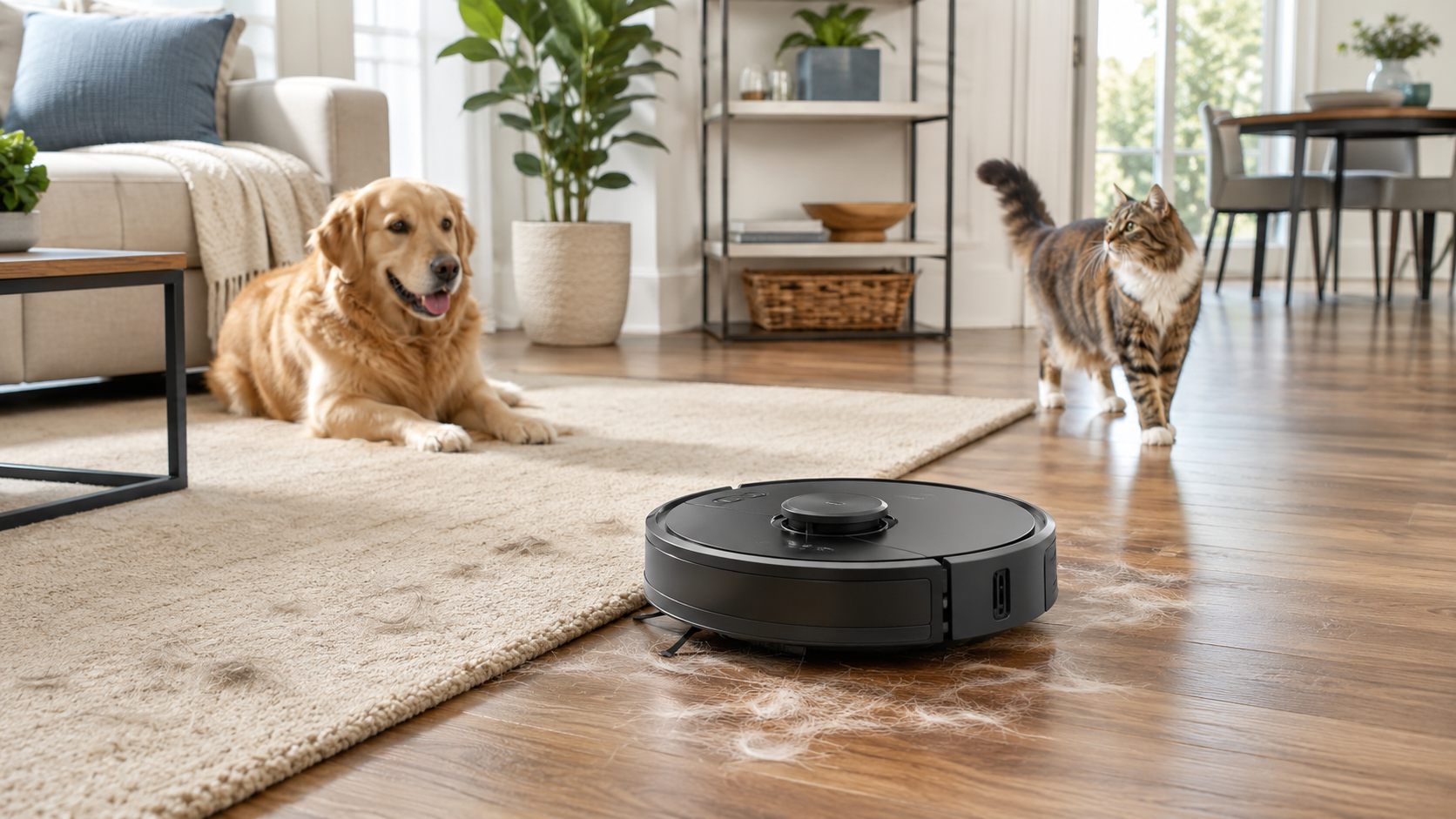
Living with pets means accepting a certain amount of fur around the house. It gathers under sofas, settles along baseboards, sticks to rugs, and somehow returns only a few hours after vacuuming. A good robot cleaner will not stop your dog or cat from shedding, but it can make the daily cleanup far easier.
The challenge is choosing a robot that works well across different surfaces. Pet hair behaves differently on carpet than it does on hardwood, laminate, or tile. Loose fur may float across hard floors, while hair on carpet can become trapped deep between the fibers. The best robot cleaner for pet hair needs enough power to handle both situations without getting stuck, scattering debris, or requiring constant brush cleaning.
This guide covers the features that matter most, how robot cleaners perform on different flooring types, and what pet owners should consider before buying.
Best Robot Cleaner for Pet Hair on Carpets and Hard Floors
The best robot cleaner for pet hair on carpets and hard floors should offer a balanced mix of strong suction, a well-designed brush system, reliable navigation, and easy maintenance. A robot that performs brilliantly on hardwood but leaves fur behind on rugs will not be useful in a mixed-floor home. The same is true of a carpet-focused model that pushes hair and cat litter around smooth floors.
Look for a robot cleaner that can:
- Detect carpet and increase suction automatically
- Pick up loose and embedded pet hair
- Move smoothly between rugs and hard floors
- Clean close to walls and furniture edges
- Resist hair tangles around the main brush
- Return to its dock and resume cleaning when needed
- Avoid pet bowls, toys, wires, and other small objects
- Trap fine dust and pet dander with effective filtration
Your ideal model will depend on how many pets you have, how heavily they shed, the size of your home, and the type of flooring in each room.
Why Pet Hair Is Harder to Clean Than Regular Dust
Pet hair is light enough to blow away but stubborn enough to cling to fabric and carpet fibers. On hard floors, a fast-spinning side brush can scatter fur instead of pulling it into the vacuum. On carpet, weak suction may remove surface hair while leaving the deeply embedded strands behind.
Long pet hair creates another problem. It can wrap around the main roller, side brush, and even the wheels. This reduces cleaning performance and forces you to stop and cut the hair away by hand.
That is why suction power alone does not tell the whole story. The shape of the brush, the airflow design, the cleaning pattern, and the robot’s ability to adjust to different surfaces all affect real-world performance.
Features That Matter Most for Pet Owners
Strong Suction With Automatic Carpet Boost
Carpets require more suction than hardwood or tile because fur becomes trapped between the fibers. A robot cleaner with automatic carpet boost can recognize when it moves onto a rug and increase power without requiring you to change the setting manually.
This feature is especially useful in homes with low-pile and medium-pile carpet. On thicker rugs, the robot also needs good wheel traction and enough clearance to avoid getting stuck.
Do not choose a model based only on the highest advertised suction number. Strong airflow, good brush contact, and an effective cleaning path can matter just as much.
Tangle-Resistant Brush Design
A traditional bristle brush may pick up pet hair well, but it can also become wrapped in long strands after every run. Rubber rollers are often easier to maintain because hair is less likely to become tightly wound around them.
Some robot cleaners use:
- Single rubber rollers
- Dual rubber rollers
- Mixed rubber-and-bristle brushes
- Removable roller ends
- Built-in hair-cutting systems
No brush is completely maintenance-free, especially in a home with long-haired cats or dogs. However, a tangle-resistant design can reduce the amount of time you spend cutting hair away from the roller.
Effective Edge Cleaning
Pet hair does not stay in the middle of a room. It gathers against walls, around furniture legs, under cabinets, and near pet beds.
A robot cleaner needs a well-positioned side brush and a dependable wall-following mode to reach these areas. Some models use a D-shaped body or extendable side brush to get closer to corners.
Edge cleaning is particularly important on hard floors, where light fur often drifts toward the sides of the room.
Good Filtration
Robot cleaners do more than collect visible hair. They also pick up fine dust, pollen, and pet dander.
A quality filter is useful for any pet-friendly home, but it matters even more when someone in the household has allergies. Check whether the filter is washable, how often it needs replacing, and whether replacement filters are easy to find.
A sealed dustbin or self-emptying base can also reduce the amount of dust released back into the room.
How Robot Cleaners Handle Different Floor Types
Low-Pile Carpet
Low-pile carpet is generally the easiest carpet type for robot cleaners. The fibers are short, so the brush can maintain good contact with the surface and pull up loose fur.
For better results, choose a robot with automatic suction adjustment and multiple cleaning passes. Pet hair often collects along carpet edges, so strong side cleaning is also helpful.
Daily cleaning can prevent fur from becoming packed into the carpet over time.
Medium-Pile and Thick Carpet
Medium-pile carpet requires more power and better brush contact. A robot may look as though it has cleaned the room while leaving deeper hair behind.
For this floor type, prioritize:
- Strong suction
- Carpet boost
- Large wheels
- Good climbing ability
- A roller that stays in contact with the surface
Thick or shag-style rugs can be difficult for many robot cleaners. The wheels may sink, the brush may catch on long fibers, or the robot may refuse to climb onto the rug. A regular vacuum may still be needed for occasional deep cleaning.
Hardwood Floors
Pet hair is easy to see on hardwood, especially in sunlight or near dark furniture. It tends to collect along walls and underneath beds and sofas.
The best robot cleaner for hardwood should pick up fur without pushing it across the floor. Controlled side-brush speed is useful because overly aggressive brushes can scatter hair, crumbs, and cat litter.
Also look for soft wheels and non-scratching rollers, particularly if your flooring has a delicate finish.
Tile and Laminate
Tile and laminate are usually easy for a robot vacuum to navigate, but grout lines and small floor gaps can trap fine debris. A strong cleaning path and steady suction help collect fur, dust, dry pet food, and litter.
On smooth floors, the robot should move methodically rather than bouncing randomly between walls. Smart mapping usually provides better coverage and reduces missed areas.
Mixed Flooring
Many pet-friendly homes have a combination of carpet, rugs, hardwood, and tile. In this situation, automatic floor detection becomes one of the most useful features.
A good multi-surface robot cleaner should move from hard floors to rugs without getting stuck and increase suction when needed. If it also has a mopping function, it should detect carpet and lift the mop pad or avoid the carpeted area completely.
Robot Vacuum and Mop Combos for Pet Owners
A robot vacuum and mop combination can be useful in homes where pets leave paw prints, water splashes, and light food messes on hard floors.
The vacuum should collect pet hair before the mop pad becomes wet. Otherwise, loose fur may stick to the pad and get dragged around the room.
Useful mopping features include:
- Automatic mop lifting on carpets
- Adjustable water levels
- Washable mop pads
- Separate clean- and dirty-water tanks
- No-mop zones
- Automatic mop washing
Robot mops work best for light, regular cleaning. They may remove fresh paw marks and surface dust, but they usually cannot replace manual scrubbing for sticky spills or dried stains.
Never run a robot cleaner over a pet accident. Even models with obstacle recognition can miss small messes, and the result can be far worse than the original problem.
Are Self-Emptying Robot Vacuums Worth It?
A self-emptying robot vacuum can be a major convenience for pet owners. Pet hair fills a small onboard dustbin surprisingly quickly, even when the floors do not appear very dirty.
A self-emptying dock allows the robot to transfer the collected debris into a larger container or bag after each cleaning session. This is especially helpful for:
- Homes with multiple pets
- Heavy seasonal shedding
- Long-haired dog or cat breeds
- Large floor plans
- People who run the robot every day
- Households with dust or dander sensitivities
Bagged systems usually offer cleaner disposal because the dust remains sealed inside the bag. However, replacement bags create an ongoing expense.
Bagless bases reduce the need to buy supplies, but emptying the container may release more dust into the air.
For a small apartment with one low-shedding pet, a standard dustbin may be enough. In a larger home with two or three pets, self-emptying can save a noticeable amount of time.
Robot Vacuum vs Regular Vacuum for Pet Hair
A robot cleaner is best used as a daily maintenance tool. It can reduce the amount of visible fur, reach under furniture, and keep high-traffic areas cleaner between deeper vacuuming sessions.
It works particularly well for:
- Daily scheduled cleaning
- Open-plan living spaces
- Under-bed and under-sofa cleaning
- Pet sleeping areas
- Kitchen and dining areas
- Reducing loose fur before it becomes embedded
A regular vacuum still performs better in several situations. It offers more power for deep carpet cleaning and can reach places a robot cannot, such as stairs, upholstery, curtains, pet beds, car seats, and narrow corners.
The most practical approach is to let the robot handle daily shedding while using a full-size or cordless vacuum for weekly deep cleaning.
Choosing a Robot Cleaner for Long Pet Hair
Long-haired pets require more brush maintenance than short-haired breeds. Hair may wrap around the roller ends, side brushes, and wheel axles.
Choose a model with a roller that can be removed easily. Detachable end caps are particularly useful because hair often collects underneath them.
A good robot cleaner for long pet hair should also have:
- A rubber or tangle-resistant roller
- Easy access to the brush chamber
- A cleaning tool for cutting wrapped hair
- A larger dustbin
- Strong suction
- Simple filter removal
Check the brush after the first few cleaning runs. This will give you a realistic idea of how often it needs maintenance in your home.
Best Features for Homes With Multiple Pets
A home with several pets produces more fur, dander, crumbs, and tracked-in dirt. A basic robot may still help, but it will need frequent emptying and cleaning.
For a multi-pet household, look for:
- A self-emptying dock
- Long battery life
- Recharge-and-resume cleaning
- Strong filtration
- A large dustbin
- Tangle-resistant brushes
- Smart room mapping
- Custom cleaning schedules
- Targeted zone cleaning
Room selection is especially useful. You can clean around the litter box more often, send the robot to the kitchen after feeding time, or schedule extra passes in the room where your pet sleeps.
How Much Suction Does a Robot Cleaner Need for Pet Hair?
There is no single suction number that guarantees excellent pet-hair pickup. Different manufacturers test and advertise suction in different ways, so comparing numbers alone may be misleading.
A robot with moderate suction and a well-designed roller may outperform a more powerful model with poor brush contact.
Real cleaning performance depends on several factors:
- Airflow
- Roller design
- Carpet detection
- Floor contact
- Filter condition
- Cleaning speed
- Navigation pattern
- Number of passes
For carpeted homes, prioritize models that increase power automatically and maintain good brush contact. On hard floors, controlled airflow and side-brush movement are important because they prevent light fur from being blown away.
Why Your Robot Cleaner May Not Be Picking Up Pet Hair
When a robot suddenly starts leaving hair behind, the problem is often related to maintenance rather than a lack of power.
Check for the following:
- The dustbin is full
- The filter is clogged
- Hair is wrapped around the main roller
- The side brush is damaged
- The wheels are blocked
- Suction is set too low
- Sensors are dirty
- The roller is worn
- The robot is making only one quick pass
- The carpet is too thick for the model
A packed dustbin restricts airflow, while a dirty filter reduces suction. Cleaning these parts regularly can restore performance without replacing the machine.
How to Stop Pet Hair From Tangling Around the Brush
Frequent maintenance is easier than removing a thick bundle of tightly wrapped hair.
After several cleaning runs:
- Remove the main roller
- Cut away wrapped strands
- Clean beneath the roller end caps
- Check the side brush
- Inspect the wheels
- Empty the dustbin
- Tap dust from the filter
- Replace worn brushes when necessary
Running the robot more often may actually reduce tangling. Short daily cleaning sessions collect smaller amounts of loose fur, while waiting several days allows large clumps to build up.
During heavy shedding seasons, check the brush more frequently than usual.
How Often Should You Run a Robot Cleaner in a Home With Pets?
Most pet owners will get the best results by running the robot once a day. Daily cleaning prevents loose fur from gathering in corners or becoming pressed into carpet.
Homes with heavy-shedding dogs, multiple cats, or active pets may benefit from two shorter cleaning sessions per day. One run can focus on the main living area, while another targets pet beds, feeding zones, or entryways.
For a single low-shedding pet, running the robot every other day may be enough.
A practical schedule could include:
- Daily cleaning in high-traffic rooms
- Extra cleaning near food bowls
- Frequent passes around litter boxes
- More cleaning during seasonal shedding
- Weekly deep cleaning with a regular vacuum
Helping Your Pet Adjust to a Robot Cleaner
Some pets ignore robot cleaners completely. Others bark, chase them, hide from them, or become nervous as soon as the motor starts.
Introduce the robot gradually. Let your pet inspect it while it is turned off, then begin with a short cleaning session in another part of the room.
You can also:
- Run the cleaner at the same time each day
- Keep the pet’s bed out of the first cleaning zone
- Leave a quiet room available
- Move food and water bowls away from the robot’s path
- Start with a lower suction setting
- Avoid running it while your pet is eating or sleeping
Do not encourage pets to ride on the robot. Apart from the risk of injury, the added weight can damage the motor and wheels.
Choosing the Right Model for Your Home
Start with your main flooring type. Carpeted homes need stronger suction, good roller contact, and automatic carpet boost. Homes with mostly hardwood or tile benefit more from controlled side brushes, edge cleaning, and gentle wheels.
Then consider your pet’s coat. Short-haired pets may produce small, stiff strands that become embedded in fabric, while long-haired pets are more likely to cause brush tangles. Double-coated breeds often shed heavily during certain times of the year, making a large dustbin or self-emptying base more valuable.
Finally, think about how much maintenance you are willing to do. A budget robot cleaner can handle basic daily shedding, but it may require frequent emptying and brush cleaning. A more advanced model may offer better obstacle avoidance, room mapping, self-emptying, and automatic mop care.
The best choice is not necessarily the most expensive robot. It is the one that matches your flooring, your pet’s shedding habits, and the way you prefer to clean.