

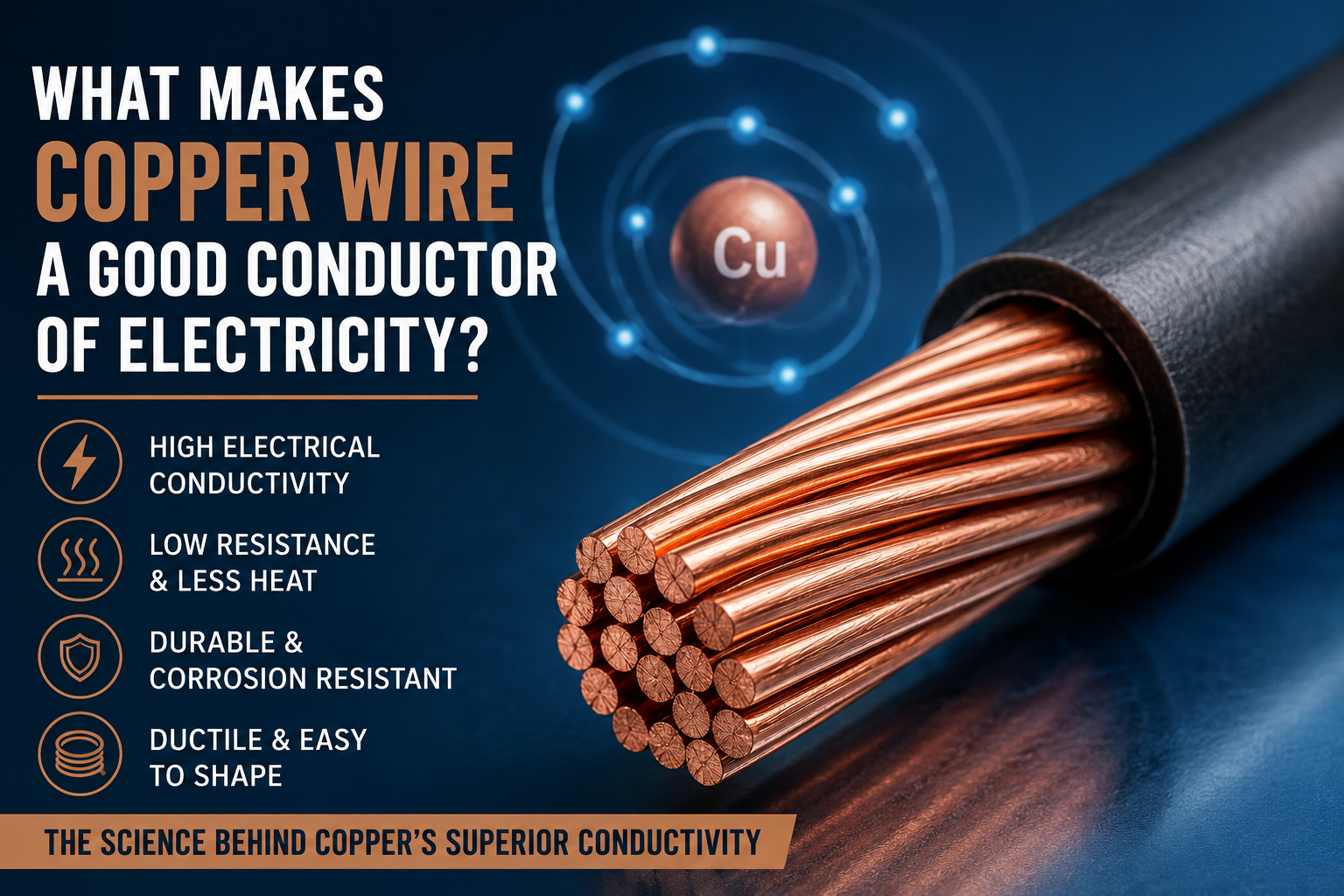
Copper wire is part of almost every electrical system around us. It carries power through homes, helps electronic devices work, connects vehicle components, and supports equipment used in factories and renewable energy systems. Although most people rarely see the wiring hidden behind walls or inside machines, it plays a major role in keeping everyday technology running.
There are several metals capable of carrying an electric current, but copper remains one of the most widely used materials for electrical wiring. It offers excellent electrical conductivity while also being flexible, durable, widely available, and practical to install.
Understanding why copper performs so well begins with looking at how electricity moves through the metal.
What Makes Copper Wire a Good Conductor of Electricity?
Copper wire is a good conductor of electricity because it allows electrons to move through it with relatively little resistance. When voltage is applied to a copper conductor, its free electrons begin moving in a more organized direction, creating an electric current.
The easier these electrons can travel, the more efficiently the wire can transfer electrical energy. Copper provides a clear path for this movement, which helps reduce wasted energy and unwanted heat.
Its strong electrical performance comes from a useful combination of properties:
- Low electrical resistance
- High electrical conductivity
- Good thermal conductivity
- Strong resistance to corrosion
- Excellent flexibility and ductility
- Long-term durability
- Reliable performance at different conductor sizes
Copper is not chosen only because it carries electricity well. An electrical conductor must also survive bending, installation, temperature changes, vibration, and years of regular use. Copper handles these demands better than many alternative materials.
Copper’s Atomic Structure Helps Electrons Move
Every material is made of atoms, and every atom contains electrons. In some materials, the outer electrons are held very tightly in place. This makes it difficult for an electric current to pass through them.
Copper behaves differently. One of the electrons in the outer part of a copper atom is held relatively loosely. Inside a piece of copper, many of these electrons can move between atoms.
When no electrical pressure is applied, the electrons move in different directions. Once voltage is introduced, they begin drifting in a shared direction. This movement forms an electric current.
A simple way to picture it is to imagine people walking through a wide hallway. If the hallway is open and has few obstacles, people can move through it easily. Copper creates a similar path for electrical charges. It does not eliminate resistance completely, but it gives electrons far more freedom than poor conductors such as rubber, glass, or plastic.
Copper Wire Has Low Electrical Resistance
Electrical resistance describes how strongly a material opposes the movement of electric current. A material with high resistance makes it harder for electrons to move, while a low-resistance material allows them to travel more freely.
Copper has low electrical resistance, which is one of the main reasons it is used in power cables and electrical circuits.
Lower resistance offers several practical benefits:
- Less electrical energy is wasted
- Voltage drop can be reduced
- Electrical devices receive a steadier power supply
- Wiring produces less unnecessary heat
- Systems can operate more efficiently
Copper wire still creates some resistance. No ordinary conductor is completely resistance-free. The actual resistance depends on several factors, including the length of the wire, its thickness, its temperature, and the purity of the copper.
For example, a long, thin copper wire will have more resistance than a short, thick one. This is why selecting the correct copper wire size is so important when designing an electrical circuit.
Copper Transfers Power With Less Energy Loss
As electricity flows through a conductor, some electrical energy is converted into heat. The greater the resistance, the more energy may be lost during this process.
Because copper wire has low resistance, it can transfer electricity with limited energy loss. This is especially valuable in systems that operate continuously or carry significant amounts of current.
Efficient power transfer helps improve the performance of:
- Household wiring
- Commercial electrical systems
- Industrial machinery
- Electric motors
- Transformers
- Generators
- Solar energy equipment
- Electric vehicle charging systems
Reduced energy loss also helps control heat buildup. However, this does not mean copper wire cannot overheat. A wire that is too small for the current flowing through it can still become dangerously hot, damage its insulation, or create a fire risk.
Why Copper Wire Is Commonly Used for Electrical Wiring
High conductivity is only one part of copper’s usefulness. A material might carry electricity well but still be unsuitable for everyday electrical installations if it is too brittle, too expensive, or difficult to connect.
Copper offers a practical balance between performance, strength, cost, and ease of use.
It Can Be Drawn Into Thin, Strong Wires
Copper is highly ductile, meaning it can be pulled into long, thin wires without breaking easily. Manufacturers can produce copper wire in many different sizes, from extremely fine strands used in electronics to thick conductors used in electrical panels and industrial equipment.
This flexibility makes copper suitable for a broad range of applications, including:
- Home electrical cables
- Circuit boards
- Automotive wiring
- Telecommunications
- Motors and generators
- Appliances
- Speakers and audio systems
- Decorative and jewelry-making projects
Copper can also be bent around corners and routed through walls, conduits, machines, and vehicles without losing its ability to conduct electricity.
Solid Copper Wire and Stranded Copper Wire
Copper conductors are commonly available in solid and stranded forms.
Solid copper wire contains a single piece of copper. It is firm, holds its shape well, and is often used in fixed electrical installations where the wire will not move regularly. Residential wiring inside walls is a common example.
Stranded copper wire is made from several smaller strands twisted or grouped together. It is more flexible than solid wire, making it useful in situations involving movement, vibration, or tight bends.
Stranded copper wire is often found in:
- Vehicles
- Extension cords
- Electronic equipment
- Machinery
- Battery cables
- Portable appliances
Neither type is automatically better in every situation. The right option depends on where the wire will be installed and how much movement it will experience.
Copper Handles Heat Well
Copper is not only an electrical conductor; it is also a good thermal conductor. This means it can spread heat through the material rather than allowing it to remain concentrated in one small area.
That property is helpful in electrical systems because current naturally creates some heat. Copper’s ability to distribute heat supports stable performance, but correct installation remains essential.
Safe copper wiring still requires:
- The correct wire gauge
- Secure electrical connections
- Suitable insulation
- Proper circuit protection
- Protection from excessive current
- Compliance with local electrical codes
Loose connections can be particularly dangerous. Even when high-quality copper wire is used, a poor connection may create extra resistance and concentrated heat.
Copper Offers Long-Term Durability
Copper wire can remain reliable for many years when it is installed correctly and protected from damaging conditions. It has good corrosion resistance and forms a surface layer that can slow further chemical reaction with the surrounding air.
However, copper is not completely immune to environmental damage. Moisture, chemicals, salt, and extreme conditions can affect exposed conductors and terminals.
Tinned copper wire is often used in marine, automotive, and outdoor environments. It is copper wire coated with a thin layer of tin, which provides additional protection against corrosion.
Copper Wire vs Aluminum Wire
Aluminum is another material commonly used to carry electricity. It is lighter than copper and often less expensive, which makes it useful in certain utility, commercial, and large-scale applications.
However, aluminum is not as conductive as copper when conductors of the same size are compared. A thicker aluminum wire is usually needed to carry the same current as a smaller copper wire.
Some important differences include:
- Copper provides higher electrical conductivity by volume
- Aluminum is lighter in weight
- Copper connections are often more mechanically stable
- Aluminum conductors may be more affordable
- Copper can carry current through a smaller wire size
- Aluminum expands and contracts more as temperatures change
- Both materials require compatible terminals and correct installation methods
Aluminum wiring is not automatically unsafe. It can perform effectively when it is properly sized, installed with approved connectors, and used in suitable applications. Copper is often preferred for building wiring because it is compact, durable, and easier to work with in many connections.
Is Copper the Best Conductor of Electricity?
Copper is one of the best practical electrical conductors, but it is not the most conductive metal.
Silver has higher electrical conductivity than copper. However, silver is much more expensive, making it impractical for household wiring, long power cables, and most large electrical systems.
Gold also conducts electricity and has excellent corrosion resistance. It is often used as a thin coating on sensitive electronic contacts and connectors. Its cost prevents it from being used as a general wiring material.
Copper offers a more useful overall balance:
- Excellent conductivity
- Reasonable cost
- Good mechanical strength
- Wide availability
- Long service life
- Easy installation
- Strong resistance to everyday corrosion
This combination explains why copper electrical wiring is found in so many residential, commercial, automotive, and industrial applications.
Common Uses of Copper Wire
Copper wire appears in systems ranging from simple household circuits to complex renewable energy equipment.
Homes and Commercial Buildings
Insulated copper wire is widely used in buildings to carry electricity safely between the electrical panel, switches, outlets, lighting fixtures, and appliances.
Common applications include:
- Lighting circuits
- Wall outlets
- Electrical panels
- Grounding systems
- Air-conditioning equipment
- Kitchen appliances
- Heating systems
- Security and alarm systems
The insulation surrounding the copper conductor helps prevent electric shock, short circuits, moisture exposure, and contact with nearby conductive materials.
Electronics and Communication Equipment
Very thin copper conductors are used throughout electronic products. They carry power and electrical signals between components, helping devices communicate and operate correctly.
Copper wire can be found in:
- Computers
- Mobile phone chargers
- Circuit boards
- Speakers
- Televisions
- Communication cables
- Telephone systems
- Networking equipment
Copper remains valuable in electronics because it can be shaped into tiny conductors while maintaining dependable electrical performance.
Motors, Transformers, and Generators
Electric motors and generators often contain coils of copper wire. These windings help create magnetic fields, convert electrical energy into motion, or produce electrical energy from movement.
Transformers also use copper windings to transfer energy between circuits and change voltage levels.
In these applications, low resistance matters because the wire may carry current for long periods. Excessive resistance would waste energy, create more heat, and reduce equipment efficiency.
Vehicles and Renewable Energy Systems
Modern vehicles contain large amounts of electrical wiring. Copper connects batteries, lights, sensors, control units, entertainment systems, safety equipment, and charging components.
Electric and hybrid vehicles often require even more copper because of their batteries, electric motors, inverters, and charging systems.
Copper is also used in:
- Solar panel installations
- Wind turbines
- Battery storage systems
- Power inverters
- Charging stations
- Grid connections
These systems depend on efficient, reliable conductors that can handle changing electrical loads.
Factors That Affect Copper Wire Conductivity
Copper naturally conducts electricity well, but several conditions influence how effectively a particular wire performs.
Wire Length
Resistance increases as a wire becomes longer. Electrons must travel through more material, creating more opportunities for collisions within the conductor.
Long cable runs can cause voltage drop, especially when the wire is too thin. Increasing the conductor size may help reduce this loss.
Wire Thickness and Gauge
A thicker copper wire generally has lower resistance and can safely carry more current than a thinner wire of the same length.
In the American Wire Gauge system, a lower gauge number usually represents a thicker wire. For example, a 10-gauge conductor is thicker than a 14-gauge conductor.
The correct copper wire gauge depends on:
- The amount of current
- Circuit voltage
- Cable length
- Installation temperature
- Insulation rating
- Whether the wire is installed in open air or conduit
- Applicable electrical codes
Choosing wire based only on price can lead to poor performance or serious safety problems.
Temperature
Copper’s electrical resistance increases as its temperature rises. As a wire becomes hotter, it becomes slightly less efficient at carrying current.
Heat may come from the surrounding environment, overloaded circuits, poor ventilation, damaged connections, or undersized conductors.
Excessive temperature can also weaken insulation, shorten the wire’s service life, and increase the risk of electrical failure.
Copper Purity
High-purity copper generally provides better conductivity because there are fewer impurities interfering with electron movement.
Low-quality conductors may contain other metals or less copper than expected. Copper-clad aluminum wire, for example, has an aluminum core covered with a layer of copper. It does not have the same electrical characteristics as pure copper wire and must be sized and used accordingly.
Buyers should check product specifications and safety certifications instead of relying only on appearance.
Connections and Physical Condition
The performance of an electrical circuit depends on more than the wire itself. Loose terminals, damaged strands, corrosion, crushed sections, and poor-quality connectors can all increase resistance.
For reliable performance:
- Connections should be clean and secure
- Damaged insulation should be repaired or replaced
- Corroded terminals should not be ignored
- Wire should not be sharply crushed or kinked
- Connectors must match the conductor material and size
- Exposed wire should be protected from moisture and chemicals
Bare Copper Wire vs Insulated Copper Wire
Bare copper wire has no protective outer covering. Insulated copper wire is wrapped in a non-conductive material such as plastic or rubber.
Bare copper wire is commonly used for grounding and bonding because these applications require a dependable conductive path. It may also be used in utility systems, industrial installations, crafts, and certain decorative projects.
Insulated copper wire is more common in circuits carrying live electrical current. The insulation helps:
- Reduce the risk of electric shock
- Prevent conductors from touching each other
- Protect against short circuits
- Shield the copper from moisture and damage
- Identify wires by color
- Support safe installation in walls and equipment
Different insulation types are designed for different temperatures, voltage levels, and environments. A wire intended for a dry indoor space may not be suitable for outdoor, underground, or high-temperature use.
How to Choose the Right Copper Wire
Choosing copper wire involves more than selecting a length and gauge. The conductor must match the electrical load, installation environment, and equipment requirements.
Before buying or installing copper wire, check:
- Wire size and gauge
- Current-carrying capacity
- Solid or stranded construction
- Bare or insulated design
- Maximum voltage rating
- Insulation temperature rating
- Indoor or outdoor suitability
- Copper purity
- Required certifications
- Local electrical regulations
A thicker wire is not always necessary, while a wire that is too thin can create voltage drop, overheating, damaged equipment, and fire hazards.
Small hobby and low-voltage projects may be manageable with basic electrical knowledge. Household circuits, electrical panels, high-current equipment, and permanent wiring should be designed or inspected by a qualified electrician. Correct wire selection allows copper’s natural conductivity, durability, and heat-handling ability to work safely and efficiently.