

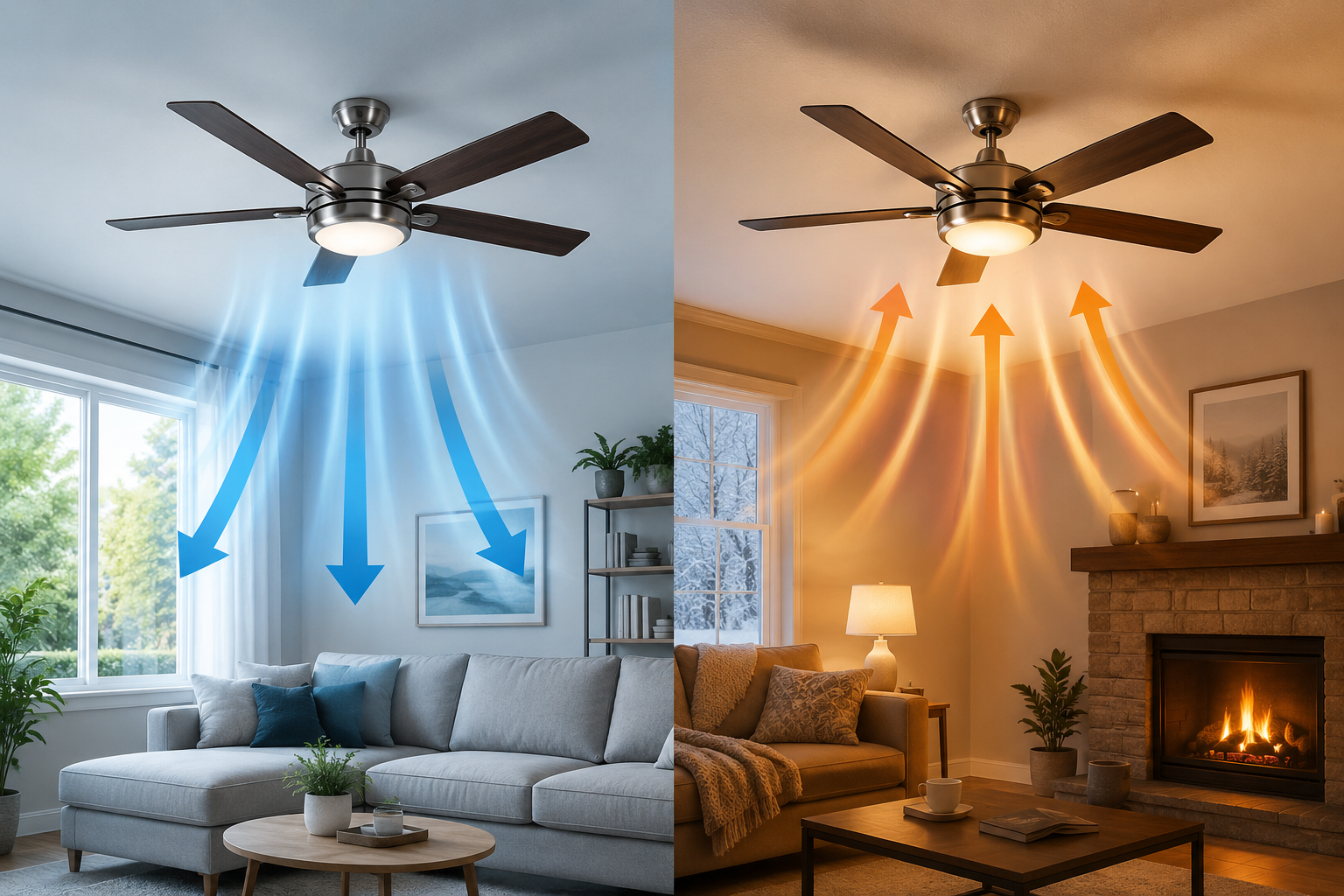
Most people switch on a ceiling fan without paying attention to which way the blades are turning. As long as the fan is moving, it must be doing its job, right?
Not always.
The direction of a ceiling fan changes how air moves through a room. One setting pushes air downward, creating a noticeable breeze, while the other pulls air upward and circulates warm air that has collected near the ceiling. Choosing the wrong setting may leave a room feeling uncomfortable, even when the fan is running at full speed.
Understanding clockwise vs counterclockwise ceiling fan direction can help you stay cooler in summer, feel warmer in winter, and use your heating and cooling systems more efficiently. It only takes a few seconds to check, but the difference can be surprisingly noticeable.
Ceiling Fan Direction
Ceiling fan direction refers to whether the blades rotate clockwise or counterclockwise when viewed from below. Most modern ceiling fans can move in either direction, and each setting serves a different purpose.
A counterclockwise rotation pushes air down into the room. This creates a direct breeze that makes your skin feel cooler. A clockwise rotation pulls air upward, helping move warm air from the ceiling toward the walls and back into the living area.
It is worth remembering that a ceiling fan does not actually lower or raise the temperature of a room. Instead, it changes how the air feels and how evenly it is distributed.
The two basic settings are:
- Counterclockwise for a cooling, downward breeze
- Clockwise for gentle circulation of warm air
- Medium or high speed during hot weather
- Low speed during cold weather
Many fans have a small reverse switch on the motor housing. Newer models may allow you to change the direction using a remote control, wall panel, or mobile app.
Clockwise vs Counterclockwise Ceiling Fan Direction
The difference between clockwise and counterclockwise rotation is more than a visual detail. Each direction creates a different airflow pattern, which is why the correct setting depends on the season.
What Happens When a Fan Spins Counterclockwise?
When a ceiling fan turns counterclockwise, the angled blades push air toward the floor. You should be able to feel a breeze when standing directly beneath it.
This downward airflow creates what is often called a wind-chill effect. Moving air helps moisture evaporate from your skin, making you feel cooler without changing the actual room temperature.
Counterclockwise is usually the best ceiling fan direction in summer because it:
- Creates a direct cooling breeze
- Helps a room feel more comfortable
- Works well alongside air conditioning
- May reduce the need for a very low thermostat setting
To check the rotation, stand below the fan and look upward. If the blades move from the top toward the left, the fan is generally turning counterclockwise.
What Happens When a Fan Spins Clockwise?
When the blades rotate clockwise, they pull air upward rather than pushing it directly down. The air then moves across the ceiling, down the walls, and back into the room.
This setting is especially helpful during winter because warm air naturally rises. In rooms with tall ceilings, a large amount of heat can remain trapped above the area where people sit or sleep.
Clockwise is usually the best ceiling fan direction in winter, but the fan should run at a low speed. A high speed may create an uncomfortable draft and defeat the purpose of gently redistributing warm air.
The Best Ceiling Fan Direction in Summer
If you are wondering which way should a ceiling fan turn to cool a room, the answer is usually counterclockwise.
During warm weather, the blades should push air down toward the people in the room. This airflow makes the space feel cooler, even though the fan is not lowering the temperature in the same way an air conditioner does.
On particularly hot days, use a medium or high fan speed to create a stronger breeze. In a bedroom or home office, a lower setting may still be enough if the fan is positioned directly above the occupied area.
A ceiling fan can also support your air-conditioning system. Because the moving air makes you feel cooler, you may be comfortable with the thermostat set slightly higher than usual. This can reduce the workload on the air conditioner and may help lower energy use.
However, there is little benefit to leaving a fan running in an empty room during summer. Fans cool people through airflow; they do not continue cooling the room after everyone leaves.
The Best Ceiling Fan Direction in Winter
During winter, your ceiling fan should generally rotate clockwise at a low speed.
Warm air from a heater, fireplace, or radiator naturally rises and gathers near the ceiling. In a standard room, this may create a small temperature difference. In a room with high or vaulted ceilings, the difference can be much more noticeable.
A clockwise fan gently pulls cooler air upward. This movement pushes the warmer air near the ceiling toward the edges of the room and gradually brings it back down along the walls.
The goal is not to create a strong breeze. You should barely feel air moving beneath the fan. If you notice a cold draft, reduce the speed or check whether the fan is turning in the correct direction.
Winter circulation can be useful in:
- Living rooms with fireplaces
- Bedrooms with high ceilings
- Open-plan spaces
- Stairwells and loft areas
- Rooms that feel warm near the ceiling but cold near the floor
Reverse the fan direction when your heating system begins regular use, then check whether the room feels more evenly heated after several minutes.
Does Ceiling Fan Direction Really Affect Room Temperature?
Ceiling fan direction affects comfort more than it affects the number shown on a thermometer.
In summer, counterclockwise rotation creates a cooling sensation by moving air across your skin. The room itself may remain at the same temperature, but it can feel several degrees more comfortable when the breeze reaches you.
In winter, clockwise rotation helps redistribute warm air. This may reduce hot and cold spots, especially in rooms where heat collects near the ceiling.
Because fans mainly influence how people experience temperature, running one in an empty room usually wastes electricity during hot weather. Winter use can be slightly different because the fan may help circulate heat through a tall or unevenly heated space, but it should still be used thoughtfully.
If a room feels uncomfortable even though the thermostat appears correct, checking the fan direction is a quick and easy place to start.
How Ceiling Fan Direction Can Help Lower Energy Bills
A ceiling fan uses electricity, but it generally requires far less power than a central air-conditioning system. The potential savings come from using the fan to support your heating or cooling system rather than expecting it to replace one completely.
In summer, a properly directed breeze may allow you to raise the thermostat while remaining comfortable. Even a small adjustment can reduce how often the air conditioner runs.
In winter, gentle air circulation may help distribute heat more evenly. When warm air reaches the occupied part of the room instead of staying near the ceiling, you may be less tempted to increase the thermostat.
It is also useful to understand ceiling fan direction vs fan speed. They work together, but they control different things:
- Direction determines where the air moves
- Speed determines how strongly the air moves
- Summer usually calls for counterclockwise rotation at medium or high speed
- Winter usually calls for clockwise rotation at low speed
Using the correct direction with the wrong speed can still make a room uncomfortable. A clockwise fan running quickly in winter, for example, may create a chilly draft instead of gently circulating heat.
How to Tell Which Direction Your Ceiling Fan Is Spinning
You do not need any tools to check the rotation. A quick visual test and a simple airflow check are usually enough.
- Turn the fan on at its lowest speed.
- Stand beneath it and look up at the blades.
- Watch the direction of movement for several seconds.
- If the blades move from the top toward the left, the fan is likely turning counterclockwise.
- If they move from the top toward the right, it is likely turning clockwise.
- Hold your hand below the fan and feel the airflow.
A strong downward breeze usually confirms counterclockwise rotation. When the fan turns clockwise at low speed, you should feel much less direct air beneath it.
Always switch the fan off and wait for the blades to stop completely before touching the motor housing or changing a manual direction switch.
How to Change the Direction of a Ceiling Fan
The method depends on the fan model, but changing the direction is usually straightforward.
Using the Reverse Switch
Many traditional ceiling fans have a small switch located on the side of the motor housing. It may be positioned above the light fixture, near the pull chains, or close to the base of the blades.
Turn the fan off and allow it to stop completely. Move the switch to the opposite position, then turn the fan back on and check the rotation.
If the fan does not change direction, switch it off again and make sure the reverse switch has moved fully into position.
Using a Remote or Wall Control
Newer ceiling fans may not have a visible switch. Instead, the direction can be changed using a remote control or wall-mounted panel.
Look for a button labeled:
- Reverse
- Direction
- F/R
- Summer/Winter
Some smart ceiling fans allow you to change the direction through a mobile app. In certain models, you may need to hold the direction button for a few seconds while the fan is stopped.
If the control is not clearly marked, check the manufacturer’s instructions rather than pressing random button combinations, as some controls are also used for pairing or resetting the remote.
What Happens When a Ceiling Fan Spins the Wrong Way?
A ceiling fan spinning the wrong way will not usually damage the motor, but it can make the room feel less comfortable and reduce the benefit of using the fan.
During summer, a fan turning clockwise may pull air away from the occupied area. Even at a high speed, you may feel little or no cooling breeze beneath it.
During winter, a fan turning counterclockwise may push air directly onto people. This can make the room feel colder, causing you to increase the thermostat even though warm air is already present.
The wrong direction can also lead homeowners to assume that:
- The fan is too small for the room
- The motor is weak
- The blades are installed incorrectly
- The air conditioner is not working properly
- A more powerful fan is needed
Before replacing a fan or calling for repairs, check both its direction and speed.
Why Your Ceiling Fan Is Not Cooling the Room
Incorrect direction is one of the most common reasons a fan does not seem effective, but it is not the only possibility.
Your ceiling fan may not be cooling the room because:
- It is turning clockwise instead of counterclockwise
- The fan speed is too low
- The fan is too small for the room
- The blades are mounted too close to the ceiling
- The ceiling is unusually high
- Furniture or architectural features are blocking airflow
- The fan is not positioned over the main occupied area
- Dust has built up on the blades
- The blade pitch is too shallow
- The room has poor overall ventilation
Fan placement matters as well. A fan installed in the center of a large room may not provide a strong breeze in seating areas near the walls. Similarly, a small fan may struggle to create noticeable airflow in an open-plan space.
Remember that a ceiling fan cools people, not the room itself. If you leave the room and return later, the air may not be any colder, even if the fan has been running the entire time.
Choosing the Right Fan Direction for Different Rooms
The seasonal direction rule is generally the same throughout the home, but fan speed and effectiveness can vary depending on the room.
Bedrooms and Living Rooms
In a bedroom, counterclockwise rotation can provide a comfortable breeze during summer. A low or medium speed is often enough at night, especially if the fan is directly above the bed.
Living rooms may require a higher speed because they are often larger and used by several people. During winter, clockwise rotation at low speed can help distribute heat from a fireplace or central heating vent.
Rooms With High or Vaulted Ceilings
A fan direction for a vaulted ceiling is especially important during colder months. Heat can collect far above the occupied area, leaving the lower part of the room feeling chilly.
Clockwise rotation at a low speed helps move this trapped warm air. Depending on the ceiling height and fan placement, it may take longer for the circulation to become noticeable.
During summer, switch the fan to counterclockwise. A downrod of the correct length can also help position the blades at a more effective height.
Kitchens and Outdoor Patios
A kitchen ceiling fan can improve comfort, but it should not interfere with a range hood or spread smoke and cooking odors into nearby rooms. Counterclockwise rotation is usually best when the goal is to create a cooling breeze.
For outdoor patios, counterclockwise rotation at medium or high speed is generally the most useful setting. The breeze can make warm, humid conditions feel more comfortable and may also make the area less appealing to flying insects.
When Should You Reverse Your Ceiling Fan Direction?
There is no single date when every homeowner should reverse a ceiling fan. Climate and indoor comfort matter more than the calendar.
It may be time to change the direction when:
- You start using air conditioning regularly
- You begin heating your home for the season
- A room feels drafty during cold weather
- The fan provides little relief during hot weather
- You move into a home and do not know the current setting
- The fan has recently been installed or repaired
- A remote control has been reset or reprogrammed
In consistently warm climates, a fan may remain counterclockwise for most of the year. In areas with colder winters, changing to clockwise rotation can be helpful as soon as warm air begins collecting near the ceiling.
A One-Minute Ceiling Fan Check for Better Comfort
Turn the fan on at low speed, stand beneath it, and confirm which way the blades are moving. Use counterclockwise rotation when you want a cooling breeze and clockwise rotation when you want to circulate warm air without creating a draft.
Then adjust the speed to suit the room. A living room on a hot afternoon may need stronger airflow, while a bedroom at night may feel better on a quieter, lower setting.
That small direction switch is easy to overlook, but it can change how comfortable a room feels, how evenly air moves, and how often you reach for the thermostat.