

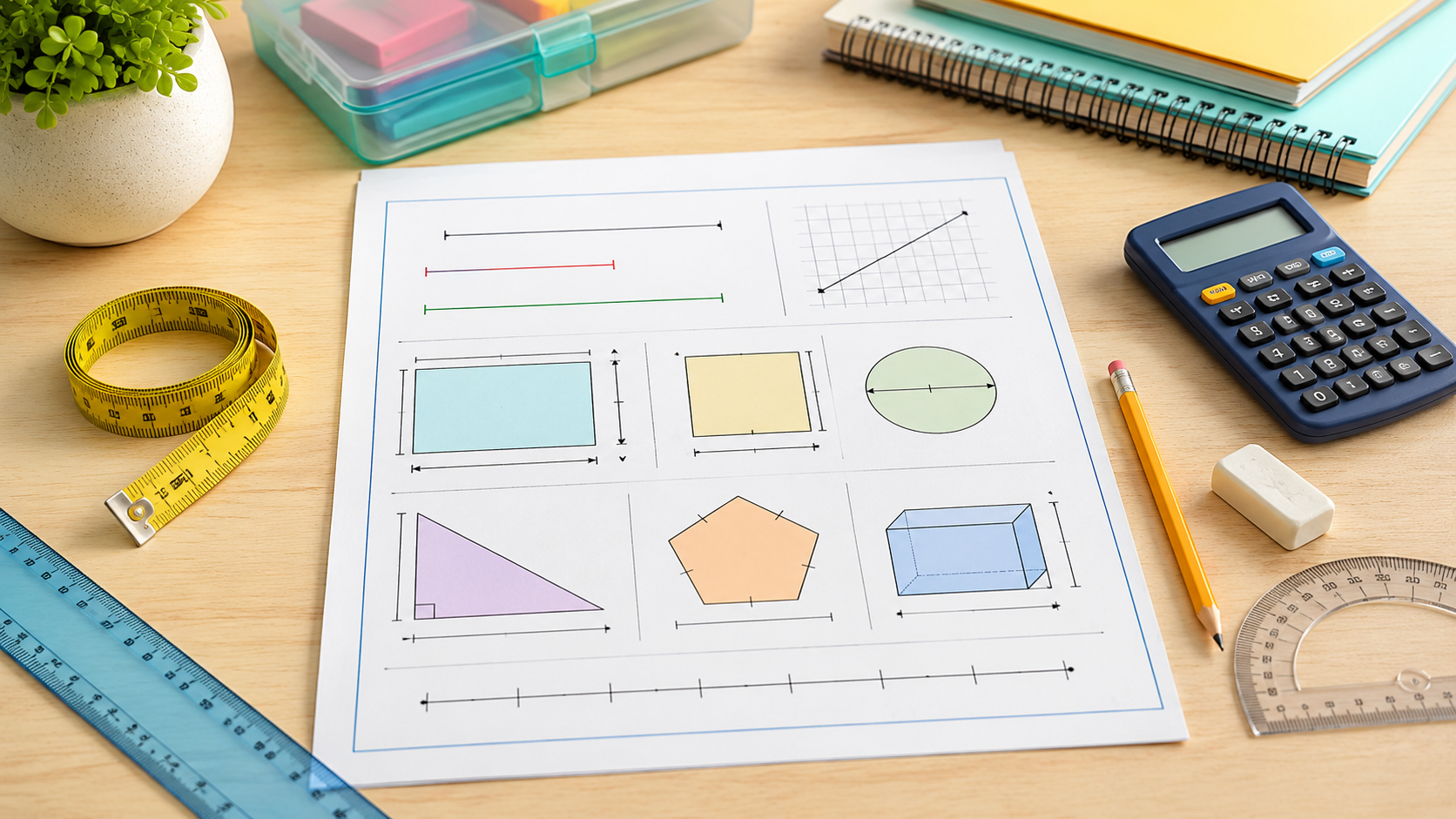
Finishing a measurement worksheet can feel satisfying, but that feeling often disappears the moment you start wondering whether your answers are actually right. Measurement questions can look simple at first, yet a small mistake with units, decimal points, or conversion rules can completely change the result.
The good news is that checking your work does not mean solving the entire worksheet again from the beginning. With a simple review process, you can spot most errors quickly and understand where your method went wrong.
Whether your worksheet covers length, mass, capacity, volume, temperature, area, or measurement tools, the same basic checking habits can help. This guide explains how to review your incredible measurements worksheet answers carefully, use an answer key properly, and feel more confident about every solution.
How to Check Your Incredible Measurements Worksheet Answers
The best way to check your answers is to look at more than the final number. A correct response should include the right calculation, the right unit, and a result that makes sense.
Start by reading the original question again. It is surprisingly easy to solve for the wrong unit or miss an important instruction. A question may give a measurement in feet but ask for the answer in inches. Another may give a capacity in liters and ask you to convert it into milliliters.
Use this quick review process:
- Read the question one more time.
- Identify the starting unit.
- Identify the unit requested in the answer.
- Check the conversion rule or formula.
- Repeat the calculation.
- Add the correct unit.
- Decide whether the result seems realistic.
- Compare your method with a trusted answer key.
Do not assume that a matching number automatically means the entire answer is correct. If the question asks for centimeters and you only write “250,” the response is incomplete. The unit is part of the answer.
Make Sure You Answered the Actual Question
Before checking any arithmetic, confirm what the problem is asking you to find.
Look for phrases such as:
- Convert to
- Find the total length
- Calculate the area
- Measure the volume
- Compare the capacity
- Round to the nearest unit
For example, suppose a question says:
“A ribbon is 4 feet long. How many inches long is the ribbon?”
The starting measurement is 4 feet, but the required answer is in inches. Since 1 foot equals 12 inches, the correct setup is:
4 × 12 = 48 inches
If you wrote 16 inches because you used the wrong conversion factor, the calculation may look neat, but the method is incorrect.
Review the Most Common Measurement Conversions
Measurement worksheets often test whether you know the relationships between common units. Learning these basic conversions makes it much easier to check your work.
Inches, Feet, Yards, and Miles
Customary length units commonly include inches, feet, yards, and miles.
Useful conversions include:
- 12 inches = 1 foot
- 3 feet = 1 yard
- 36 inches = 1 yard
- 1,760 yards = 1 mile
- 5,280 feet = 1 mile
When converting from a larger unit to a smaller unit, the number usually becomes larger. For example, 5 feet equals 60 inches.
When converting from a smaller unit to a larger unit, the number usually becomes smaller. For example, 36 inches equals 3 feet.
This size check is a quick way to spot a mistake. If you convert 6 feet into inches and get 0.5 inches, you know something went wrong.
Millimeters, Centimeters, Meters, and Kilometers
The metric system is based on groups of 10, 100, and 1,000, which makes many conversions easier.
Common metric relationships include:
- 10 millimeters = 1 centimeter
- 100 centimeters = 1 meter
- 1,000 millimeters = 1 meter
- 1,000 meters = 1 kilometer
Suppose you need to convert 3.5 meters into centimeters. Since each meter contains 100 centimeters, multiply:
3.5 × 100 = 350 centimeters
You can also think of this as moving the decimal point two places to the right. However, avoid moving the decimal automatically without first checking the direction of the conversion.
Mass, Weight, Capacity, and Volume
An incredible measurements worksheet may also include questions about weight, mass, liquid capacity, or volume.
Common conversions include:
- 16 ounces = 1 pound
- 2,000 pounds = 1 ton
- 1,000 milligrams = 1 gram
- 1,000 grams = 1 kilogram
- 1,000 milliliters = 1 liter
- 2 cups = 1 pint
- 2 pints = 1 quart
- 4 quarts = 1 gallon
Be careful when customary and metric measurements appear in the same worksheet. You cannot convert ounces into grams using the same simple rules used for metric units unless a specific conversion factor is provided.
Compare Metric and Customary Units Carefully
One of the most common mistakes in measurement problems is mixing up the metric and customary systems.
Customary units include:
- Inches
- Feet
- Yards
- Miles
- Ounces
- Pounds
- Cups
- Pints
- Quarts
- Gallons
Metric units include:
- Millimeters
- Centimeters
- Meters
- Kilometers
- Milligrams
- Grams
- Kilograms
- Milliliters
- Liters
If a problem uses only metric units, you will often multiply or divide by 10, 100, or 1,000. Customary conversions are less predictable. Feet to inches requires multiplying by 12, while yards to feet requires multiplying by 3.
Write the conversion relationship next to the problem before calculating. This small step can prevent you from choosing the wrong number.
For example:
- Feet to inches: multiply by 12
- Yards to feet: multiply by 3
- Meters to centimeters: multiply by 100
- Liters to milliliters: multiply by 1,000
Seeing the relationship on paper makes the calculation easier to verify.
Check Every Answer for the Correct Unit
A measurement answer is not complete without a unit.
The number 25 could mean 25 inches, 25 liters, 25 kilograms, or 25 degrees. Without a unit, the reader cannot tell what the number represents.
When reviewing your worksheet, check that every response includes the unit requested in the question.
Pay attention to:
- Inches, feet, yards, or miles
- Millimeters, centimeters, meters, or kilometers
- Ounces, pounds, grams, or kilograms
- Cups, pints, quarts, gallons, milliliters, or liters
- Degrees Celsius or degrees Fahrenheit
- Square units for area
- Cubic units for volume
Do Not Confuse Length, Area, and Volume
Length measures distance in one direction. Area measures the surface inside a shape. Volume measures the space inside a three-dimensional object.
That means the units are written differently:
- Length: 8 feet
- Area: 64 square feet
- Volume: 512 cubic feet
If you calculate the area of a rectangle and write “24 centimeters” instead of “24 square centimeters,” the number may be correct, but the unit is not.
The same applies to volume. A box may hold 60 cubic centimeters, not simply 60 centimeters.
Repeat the Calculation Using Another Method
One of the strongest ways to check incredible measurements worksheet answers is to solve the problem a second way.
You do not always need a completely different formula. Sometimes reversing the calculation is enough.
Use Reverse Conversions
Suppose you converted 7 feet into 84 inches.
To check the result, divide the answer by 12:
84 ÷ 12 = 7 feet
Because you returned to the original measurement, the conversion is likely correct.
Reverse checking works well for:
- Inches and feet
- Feet and yards
- Centimeters and meters
- Milliliters and liters
- Ounces and pounds
- Grams and kilograms
Estimate Before Accepting the Answer
Estimation helps you catch answers that are far too large or too small.
Imagine you convert 2 meters into centimeters and get 20,000 centimeters. You may not remember the exact answer immediately, but you should notice that 20,000 seems much too large.
Ask yourself:
- Should the final number be larger or smaller?
- Does the decimal point look reasonable?
- Did I multiply when I should have divided?
- Would this measurement make sense in real life?
If a pencil is listed as 40 meters long, the answer is clearly unrealistic. A real-world check can often reveal an error faster than repeating the entire calculation.
Check Measurement Word Problems Step by Step
Measurement word problems can be more challenging because the conversion is hidden inside a story.
A reliable method is to slow down and separate the information.
- Read the whole problem.
- Underline the measurements.
- Circle the units.
- Identify what the question asks.
- Convert units so they match.
- Complete the calculation.
- Add the correct unit.
- Check whether the answer is realistic.
Ignore Information You Do Not Need
Some word problems include extra details.
For example:
“Lena bought a blue ribbon for $4. The ribbon is 3 yards long. She uses 2 feet for a project. How many feet of ribbon remain?”
The ribbon’s color and price do not matter. The useful information is:
- Total length: 3 yards
- Amount used: 2 feet
Convert 3 yards to feet:
3 × 3 = 9 feet
Then subtract:
9 − 2 = 7 feet
The correct answer is 7 feet.
Make Units Match Before Adding or Subtracting
You cannot correctly add or subtract measurements written in different units until you convert them.
For example, do not directly subtract 8 inches from 3 feet. First convert 3 feet into inches:
3 × 12 = 36 inches
Then subtract:
36 − 8 = 28 inches
This rule also applies to capacity, mass, and metric measurements.
Review Answers Involving Measurement Tools
Some worksheet questions ask you to read a ruler, measuring cup, thermometer, clock, or scale.
In these questions, the biggest challenge is often understanding what each mark represents.
Check the Starting Point
When measuring an object with a ruler, make sure the object begins at zero. If it begins at the 1-inch mark and ends at the 6-inch mark, the object is not 6 inches long.
Its actual length is:
6 − 1 = 5 inches
The same idea applies to number lines and measuring scales.
Understand the Small Marks
Not every mark on a ruler or thermometer has a printed number.
Before reading the measurement, count how many equal spaces appear between two labeled values.
For example, if there are four equal spaces between 1 inch and 2 inches, each space represents one-quarter inch.
Check:
- Whether the ruler uses inches or centimeters
- Whether the measuring cup uses cups, ounces, or milliliters
- Whether the thermometer shows Celsius or Fahrenheit
- Whether the scale increases by ones, twos, fives, or tens
- Whether you counted marks or spaces correctly
A single missed line can change the answer.
Look for Common Measurement Mistakes
When checking your worksheet, look specifically for the errors students make most often.
These include:
- Multiplying instead of dividing
- Dividing instead of multiplying
- Using the wrong conversion factor
- Moving the decimal point in the wrong direction
- Forgetting the unit
- Mixing metric and customary units
- Adding measurements before making the units match
- Confusing perimeter with area
- Using regular units instead of square units
- Using square units instead of cubic units
- Reading a ruler from the wrong starting point
- Rounding too early
- Copying a number incorrectly
It can help to check your worksheet in two rounds.
During the first round, review only the units. During the second round, check the calculations. Looking for one type of mistake at a time makes errors easier to notice.
Use an Incredible Measurements Worksheet Answer Key Properly
An incredible measurements worksheet answer key can be useful, but only when you use it as a learning tool.
Try not to look at the answers before attempting the problems yourself. Instead, complete the worksheet first and then compare your results.
A useful approach is to:
- Mark the questions that do not match.
- Review the conversion rule.
- Compare your calculation steps.
- Correct the problem without copying.
- Explain what caused the mistake.
- Try a similar problem on your own.
Compare the Method, Not Only the Number
Two students may reach the same number using different steps, but that does not always mean both methods are correct.
For each answer, check:
- The conversion factor
- The operation used
- The order of the steps
- The formula
- The final unit
If step-by-step explanations are available, compare your setup with the worked solution. Understanding why the method works is more useful than simply replacing your answer with the correct one.
Practice the Types of Questions You Missed
When you find an incorrect answer, identify the skill behind the mistake.
You may need more practice with:
- Length conversions
- Measurement word problems
- Mass and weight
- Capacity and volume
- Temperature
- Area and perimeter
- Reading rulers and scales
- Decimal conversions
- Multi-step problems
A printable measurement review worksheet, measurement conversion quiz, or set of extra practice questions can help strengthen weaker areas.
Do not repeat only the exact question you missed. Try two or three similar questions with different numbers. That shows whether you understand the method rather than memorizing one answer.
Create a Personal Measurement Reference Sheet
A one-page reference sheet can make practice much easier.
Include:
- Common customary conversions
- Common metric conversions
- Area formulas
- Perimeter formulas
- Volume formulas
- Notes about square and cubic units
- A reminder to make units match
- A short answer-checking checklist
Use the sheet while practicing, then gradually try solving problems without it.
Build a Simple Answer-Checking Routine
A consistent routine helps you avoid rushing and makes every measurement worksheet easier to review.
Use these steps each time:
- Read the question again.
- Identify the starting unit.
- Identify the requested unit.
- Write the correct conversion rule or formula.
- Repeat the calculation.
- Use a reverse operation when possible.
- Include the correct unit.
- Estimate whether the answer makes sense.
- Compare your method with the answer key.
- Redo incorrect problems without looking at the solution.
Checking your incredible measurements worksheet answers this way helps you find more than simple arithmetic mistakes. It also shows whether you understand measurement conversions, formulas, units, and real-world values. Over time, the review process becomes faster, and you will start noticing mistakes before they reach the final answer.