

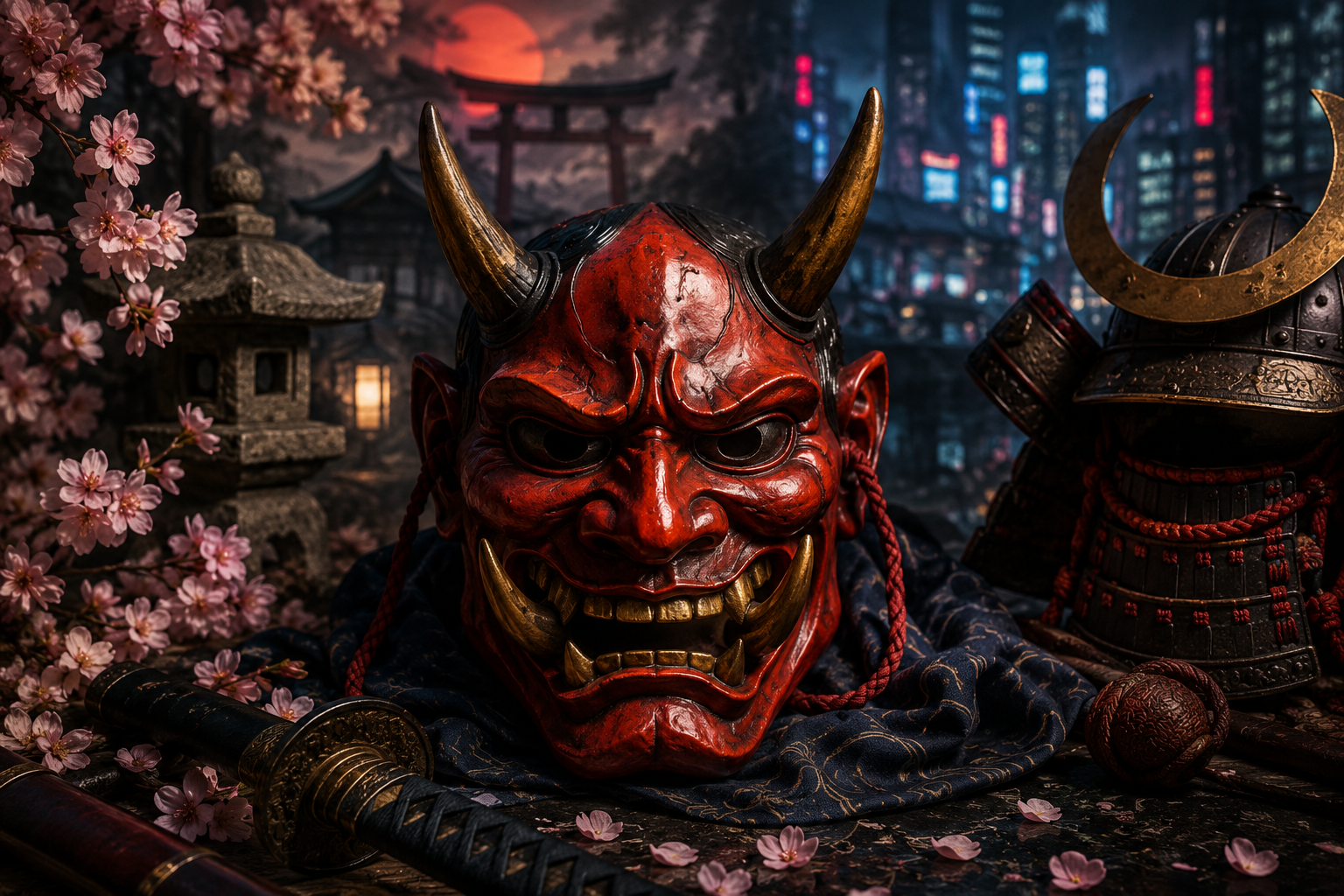
With curved horns, sharp fangs, fierce eyes, and bold colors, an oni mask is difficult to overlook. Its dramatic appearance can feel frightening, mysterious, or powerful depending on how it is presented. Today, these masks appear on tattoo sleeves, gaming characters, streetwear, cosplay costumes, digital illustrations, and even the walls of modern homes.
That global visibility is relatively recent. The traditional Japanese oni mask comes from a much older cultural world shaped by folklore, festivals, theater, religion, and storytelling. For centuries, oni were familiar figures in Japan, but audiences in other countries had limited exposure to them.
That changed as Japanese entertainment and visual culture reached a wider international audience. Anime introduced viewers to supernatural creatures inspired by Japanese folklore. Video games turned oni imagery into armor, character skins, and intimidating villains. Tattoo artists gave the mask new personal meanings, while fashion designers and digital creators reshaped it for modern tastes.
The result is a symbol that remains connected to Japanese tradition while constantly taking on new forms.
How Oni Masks Became Popular Outside Japan
Oni masks did not become internationally popular because of one movie, fashion trend, or video game. Their rise happened through several creative industries at the same time.
As Japanese films, manga, anime, and games became easier to access around the world, more people encountered imagery based on traditional myths. The Japanese oni mask stood out because its design was instantly recognizable, even to viewers who knew very little about its history.
Its popularity also grew because the mask could fit into many different settings. It looked natural on a supernatural anime character, a samurai-inspired warrior, a horror villain, or a futuristic cyberpunk fighter. Outside entertainment, it became a strong visual choice for tattoos, clothing, artwork, costumes, and room décor.
People were also drawn to the oni mask meaning. Although oni are often described as demons or ogres, their symbolism is not limited to simple ideas of good and evil. They may represent fear, anger, punishment, protection, inner conflict, or the consequences of destructive behavior.
This flexibility made the mask appealing to international audiences. Some people admired its cultural history, while others connected with what it represented on a personal level.
The Traditional Roots of the Japanese Oni Mask
Oni in Japanese Folklore
In Japanese folklore, oni are supernatural beings commonly portrayed with horns, fangs, wild hair, and powerful bodies. They may carry heavy clubs and wear clothing made from animal skins. Their appearance is designed to create a sense of danger and strength.
Calling an oni a Japanese demon is a useful starting point, but it does not tell the whole story. Oni can appear as cruel creatures that punish people, guard the underworld, spread chaos, or represent uncontrolled emotions. In other stories and traditions, frightening oni figures may be used to drive away bad luck or protect a place from harmful forces.
This complexity is an important part of Japanese oni mask history. The frightening face is not always meant to celebrate evil. Sometimes it represents something people are trying to confront, control, or keep away.
Festivals, Customs, and Performances
Oni have long appeared in Japanese festivals and seasonal customs. One of the best-known examples is Setsubun, an event associated with the arrival of spring. During the celebration, people traditionally throw roasted soybeans while calling for oni to leave and good fortune to enter.
In family celebrations, someone may wear an oni mask while others throw beans toward them. The custom presents the oni as a symbol of misfortune or negativity being driven out of the home.
Traditional performances have also used expressive masks to communicate supernatural power, anger, grief, and fear. A mask allows a performer to create an immediate emotional impression without relying entirely on dialogue.
These customs gave oni imagery a cultural meaning long before it appeared on modern merchandise or social media.
Are Oni Masks Good or Evil?
The answer depends on the story and the context.
Some oni are clearly presented as dangerous beings. They may punish wrongdoers, attack travelers, or represent destructive behavior. However, a scary Japanese demon mask can also be used as a protective image. A frightening face may be intended to scare away evil rather than welcome it.
This is one reason the oni mask meaning can be difficult to reduce to one definition. It may represent anger, but it can also represent control over anger. It may symbolize danger, but it can also be worn as a sign of protection. That uncertainty is part of what makes the mask so compelling.
A Visual Style That Crossed Cultural Boundaries
The appearance of an oni mask played a major role in its international success. Even when the viewer does not know the folklore behind it, the design creates an immediate reaction.
Traditional oni mask designs often include:
- Large horns
- Wide or sharply angled eyes
- Exposed fangs
- Heavy eyebrows
- Deep facial lines
- Flared nostrils
- Bright red, blue, black, or gold details
These features are easy to adapt. An artist can create a detailed handmade oni mask or reduce the face to a clean graphic for a T-shirt. A game designer can turn it into armor, while a tattoo artist can blend it with flowers, smoke, snakes, or waves.
The basic identity of the mask remains visible even after its style changes.
Oni Mask Colors and Their Meanings
Color has also helped the mask stand out in art, fashion, and tattoos.
The red oni mask meaning is often linked with aggression, passion, power, danger, or intense emotion. Red creates a bold look, which is why it appears frequently in tattoo designs and costume masks.
A blue oni mask may suggest coldness, sadness, control, intelligence, or spiritual depth. Black designs are often connected with mystery, strength, authority, or darkness. Gold details can make the mask feel more ceremonial, decorative, or luxurious.
These meanings are not fixed rules. Modern artists often choose colors based on style rather than tradition. A neon pink or metallic silver cyberpunk oni mask, for example, may be created mainly for visual impact.
Anime Brought Oni Imagery Into Everyday Pop Culture
Anime played one of the biggest roles in introducing oni imagery to global audiences. As Japanese animation became widely available through television, streaming services, and online fan communities, viewers encountered stories filled with spirits, demons, warriors, masks, and supernatural transformations.
Oni masks in anime often appear on mysterious fighters, dangerous villains, guardians, or characters hiding their identity. Even when a character is not described as an oni, the design may borrow familiar features such as horns, fangs, red skin, or an exaggerated expression.
These visual choices encouraged international fans to explore the folklore behind them.
Anime audiences were especially drawn to oni masks because they can suggest several things at once. A masked character may be hiding emotional pain, controlling a dangerous power, preparing for battle, or separating their public identity from their true self.
Fan art helped carry the trend further. Artists created oni mask wallpapers, profile pictures, posters, clothing designs, and character concepts. Social media allowed those images to circulate far beyond the original series that inspired them.
Video Games Turned Oni Masks Into Symbols of Power
Video games gave the oni mask another global stage.
Game developers often use visual shortcuts to tell players what kind of character they are facing. A huge warrior wearing a samurai oni mask immediately appears dangerous, skilled, and difficult to defeat. The mask creates a sense of power before the character says or does anything.
Oni-inspired designs now appear on villains, bosses, assassins, armored warriors, demons, and playable heroes. They can be found in historically inspired games as well as fantasy, horror, and science-fiction settings.
The samurai oni mask meaning is often shaped by modern entertainment rather than one traditional definition. In games, it may represent fearlessness, aggression, authority, revenge, or supernatural strength.
Character customization made the image even more popular. Players could choose an oni-style mask for their avatar, purchase it as downloadable content, or unlock it as a reward. Once the mask became part of player identity, it was no longer limited to the story of a single game.
Gaming merchandise, livestreams, fan communities, and online avatars helped turn oni masks into a broader international aesthetic.
Oni Mask Tattoos Created Personal Meanings
Tattoo culture gave the mask a more individual form of expression.
Japanese-inspired tattoo art has influenced artists around the world for decades. Dragons, koi fish, waves, tigers, cherry blossoms, and masks all became popular elements in large, detailed compositions.
The oni mask tattoo meaning can vary greatly from person to person. Some people choose it to represent a struggle they have survived. Others see it as a reminder to control anger, face fear, or accept the darker parts of their personality.
Common interpretations include:
- Protection from negative influences
- Courage during difficult periods
- Strength after personal hardship
- Awareness of destructive emotions
- The conflict between discipline and rage
- A willingness to confront fear
A Japanese oni mask tattoo also gives artists room to create highly expressive work. The horns, teeth, eyes, and facial lines can be exaggerated to match the wearer’s preferred style.
Popular Oni Mask Tattoo Ideas
Oni masks are often combined with other images to build a larger story.
An oni mask and samurai tattoo may explore themes of discipline, violence, duty, or the conflict between control and aggression. An oni mask with a snake can suggest danger, change, rebirth, or hidden threats.
Cherry blossoms create a softer contrast. Because the flowers are associated with beauty and the temporary nature of life, they can add a sense of balance to an otherwise aggressive image.
Other popular oni mask tattoo ideas include:
- Oni mask sleeve tattoos
- Black and grey oni mask tattoos
- Oni masks with dragons
- Oni masks surrounded by flames
- Oni masks with Japanese waves
- Red oni mask tattoos
- Oni masks paired with swords
- Oni masks with smoke and clouds
Red remains one of the most popular tattoo colors because it draws attention to the expression and reinforces the mask’s intensity. Black-and-grey designs, however, often create a darker and more realistic appearance.
Oni Mask vs Hannya Mask: A Common Source of Confusion
People outside Japan often confuse oni masks with Hannya masks. Both may have horns, sharp teeth, and a frightening expression, but their traditional meanings are different.
An oni mask generally represents an ogre-like supernatural creature. Its appearance is often broad, heavy, and physically threatening.
A Hannya mask traditionally represents a woman transformed by jealousy, anger, pain, or obsession. Although the face appears demonic, it also expresses sadness and emotional suffering. Depending on the viewing angle, the expression may seem furious in one moment and sorrowful in another.
The oni mask vs Hannya mask discussion became especially common among tattoo clients, anime fans, collectors, and cosplayers. Online comparisons encouraged people to look more closely at Japanese mask traditions instead of treating every horned face as the same symbol.
That curiosity helped expand interest in the stories and emotions behind the designs.
Cosplay Made Oni Masks Easier to Wear and Create
Anime conventions, gaming events, costume contests, and Halloween celebrations brought oni masks into physical spaces around the world.
An oni mask cosplay can transform a simple costume into something memorable. It may be paired with robes, fantasy armor, samurai-inspired clothing, horns, swords, or futuristic accessories.
Cosplayers also began creating their own masks rather than buying finished products. Online tutorials showed people how to make an oni mask from cardboard, clay, resin, leather, or EVA foam. More experienced makers used 3D printers to create custom shapes with movable jaws, detailed teeth, or built-in lighting.
Popular DIY oni mask projects often include:
- Foam masks for lightweight costumes
- Cardboard masks for beginners
- Resin masks with painted details
- 3D-printed cyberpunk designs
- Wooden masks for decorative displays
- LED masks for futuristic cosplay
The growth of handmade oni mask communities made the design more accessible. Fans could adjust the shape, color, and expression to match a character or create something completely original.
Streetwear Reimagined the Oni Mask
The oni mask also found a natural place in streetwear.
Its strong lines and aggressive expression work well as graphic art. Designers began placing oni faces on hoodies, jackets, T-shirts, caps, sneakers, and bags. Some designs used traditional patterns, while others mixed the mask with graffiti, flames, skulls, racing graphics, or neon lettering.
Oni masks in streetwear often communicate confidence, rebellion, mystery, or individuality. The design appeals to people interested in Japanese pop culture, tattoo art, gaming, custom cars, and urban fashion.
Independent artists played a major role in this shift. Online stores and print-on-demand platforms allowed small creators to sell Japanese oni mask designs directly to international customers. A graphic that once might have remained inside a local art community could suddenly reach buyers across several countries.
Cyberpunk Art Gave the Oni Mask a Futuristic Identity
Few modern adaptations have changed the mask as dramatically as cyberpunk art.
A cyberpunk oni mask may have metallic skin, glowing eyes, mechanical horns, cables, ventilation panels, or electronic displays. Artists often place it against a dark city filled with neon signs, rain, and futuristic technology.
The combination works because oni mythology and cyberpunk storytelling share similar themes. Both can explore power, fear, violence, transformation, identity, and the loss of control.
Modern oni mask art also creates an interesting contrast between the past and the future. The face comes from an old mythological tradition, but the materials and setting belong to an imagined technological world.
This style has become popular in digital illustration, gaming setups, album artwork, clothing, posters, and 3D-printed masks.
Social Media Accelerated the Trend
Social media made oni mask imagery easier to discover, copy, reinterpret, and share.
Tattoo artists posted finished sleeves and design sketches. Cosplayers uploaded transformation videos. Digital artists shared futuristic oni concepts, while craftspeople documented their mask-making process from the first piece of foam to the final coat of paint.
Popular content included:
- Oni mask drawing tutorials
- Tattoo time-lapse videos
- Cosplay makeup and costume reveals
- Oni mask wallpaper collections
- Streetwear photography
- Painting demonstrations
- 3D-printing projects
- Gaming room decoration ideas
The design performs well online because it remains clear even on a small screen. Its eyes, horns, and teeth create an immediate focal point.
Hashtags and creative communities also helped people find artists from other countries. A traditional mask, a digital illustration, and a modern tattoo could appear beside one another in the same search, showing how widely the image had evolved.
Oni Masks Became Popular as Wall Décor
Not everyone wants to wear an oni mask. Many people now display one as art.
Oni mask wall décor is especially common in gaming rooms, tattoo studios, home offices, themed bedrooms, martial arts spaces, restaurants, and entertainment areas. The mask adds a strong visual feature without requiring a large collection of decorations.
Buyers can choose from several materials. Wooden masks often feel more natural or traditional, while resin versions are lightweight and widely available. Metal masks create an industrial look, and 3D-printed pieces allow for unusual shapes and custom details.
Japanese oni mask wall art can also take the form of prints, paintings, carved panels, or digital posters. Some pieces follow traditional oni mask patterns, while others use modern graffiti, anime, or cyberpunk styles.
The growth of international online marketplaces made these products much easier to find. Collectors no longer needed access to a specialist shop to purchase a handmade or decorative oni mask.
How the Meaning Changed Outside Japan
As oni masks entered new creative spaces, their meaning became more personal and less fixed.
A tattoo wearer may see the mask as a symbol of survival. A gamer may associate it with power and intimidation. A collector may value it as an example of Japanese-inspired craftsmanship, while a fashion fan may simply admire the design.
The modern meaning often depends on several details:
- The mask’s color
- Its facial expression
- The objects placed around it
- The reason it is worn or displayed
- The style used by the artist
- The owner’s personal experiences
This freedom has helped the oni mask remain popular, but it also makes cultural awareness important. A modern design can be inspired by tradition without being presented as historically authentic.
Learning about Japanese oni mask history allows people to appreciate the image beyond its frightening appearance. Oni masks are connected to folklore, festivals, performance, religious customs, and generations of artistic expression.
Their popularity outside Japan continues because they can exist in several worlds at once. They are ancient and modern, frightening and protective, traditional and experimental. Whether they appear in anime, video games, tattoos, cosplay, streetwear, digital art, or home décor, their dramatic expression continues to attract people who see power, mystery, conflict, and creativity in the face of the oni.