

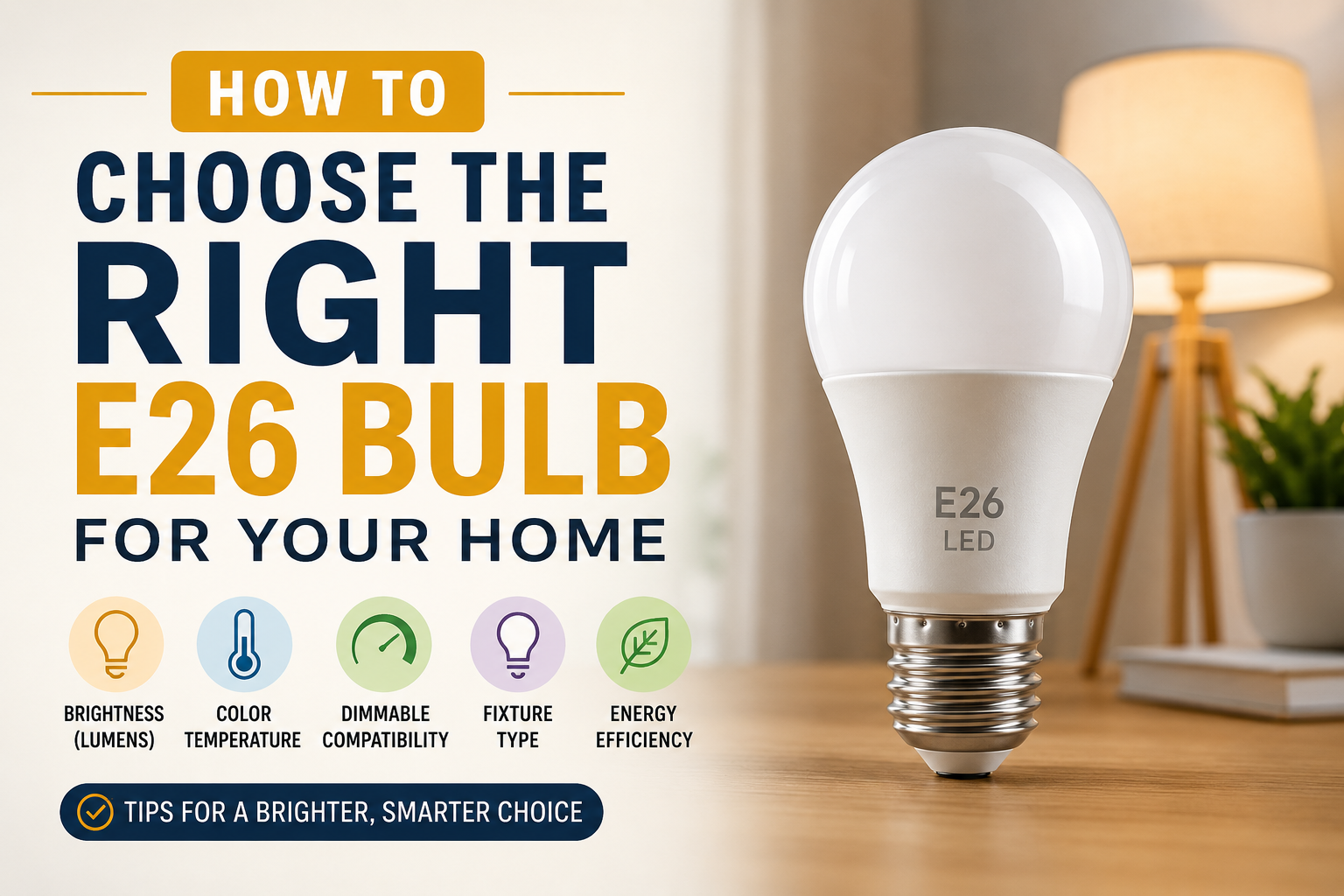
Buying a light bulb should be simple, but the number of options on store shelves can quickly make it confusing. Two bulbs may have the same screw base yet produce completely different levels of brightness, color, and energy use. One may work perfectly in an open table lamp, while the other may fail early inside an enclosed ceiling fixture.
An E26 bulb is one of the most common household lighting options, particularly in North America. However, finding the right one involves more than checking whether it screws into the socket. You also need to think about the bulb’s shape, actual wattage, lumen output, color temperature, voltage, dimming ability, and intended use.
Understanding these details can help you choose a bulb that fits properly, provides comfortable light, and does not need to be replaced sooner than expected.
How to Choose the Right E26 Bulb
The right E26 bulb depends on the fixture, the room, and the type of lighting you want. A bright daylight bulb may be useful in a garage but uncomfortable beside your bed. A decorative Edison bulb may look attractive in an exposed pendant, yet it may not provide enough light for reading or cooking.
Before purchasing an E26 bulb, consider these basic factors:
- The base and bulb shape
- Brightness in lumens
- Actual energy use in watts
- Color temperature
- Fixture size and wattage limit
- Dimming compatibility
- Indoor or outdoor placement
- Open or enclosed fixture design
- Voltage requirements
- Smart lighting features
Looking at these details before buying can prevent common problems such as flickering, buzzing, overheating, poor brightness, or a bulb that simply does not fit.
Make Sure You Need an E26 Bulb Base
The first step is confirming the socket size. In the term “E26,” the letter “E” refers to the Edison screw design, while “26” indicates that the metal base is approximately 26 millimeters wide.
An E26 bulb is also known as a medium-base bulb. It is commonly used in table lamps, floor lamps, ceiling fixtures, pendant lights, bathroom vanities, ceiling fans, and some outdoor fixtures.
You can identify an E26 bulb in several ways:
- Check the printing on your old bulb
- Look for an E26 marking near the socket
- Read the fixture label or instruction manual
- Measure the width of the screw base
- Compare it with common E12 and E27 bases
An E12 base is much smaller and is often found in chandeliers, night-lights, and decorative fixtures. An E27 bulb base is extremely close in size to E26, but voltage and safety requirements can differ depending on the country and product.
Although E26 and E27 bulbs may sometimes physically fit the same socket, you should always confirm the voltage rating before using one in place of the other.
Understand E26 vs A19 Bulbs
E26 and A19 are often used as though they mean the same thing, but they describe different parts of a light bulb.
E26 describes the screw base. A19 describes the familiar rounded bulb shape used in many household lamps. As a result, a bulb can be both A19 and E26 at the same time.
Many standard household bulbs are A19 bulbs with an E26 base, but not every E26 bulb has an A19 shape. The same base can be found on:
- Globe bulbs
- Vintage Edison bulbs
- BR30 reflector bulbs
- PAR bulbs
- Smart bulbs
- Grow bulbs
- Appliance bulbs
- Photography bulbs
When replacing a bulb, check both the base and the shape. An E26 base may fit the socket, but a wide globe or tall vintage bulb may not fit inside the shade or fixture cover.
Choose the Right Brightness in Lumens
Wattage used to be the main way people compared light bulbs. With modern LED lighting, lumens are more useful because they measure the amount of visible light a bulb produces.
Watts tell you how much electricity the bulb consumes. Lumens tell you how bright it will appear.
A rough household brightness guide is:
- 450 lumens for gentle accent lighting
- 800 lumens for a common 60-watt replacement
- 1,100 lumens for a 75-watt replacement
- 1,600 lumens for a 100-watt replacement
- More than 2,000 lumens for large work areas
The brightest E26 bulb is not automatically the best choice. Too much light can make a bedroom feel harsh, create glare on screens, or make a small room uncomfortable.
Think about what you normally do in the space. A bedside lamp may only need soft, focused light. A kitchen, workshop, or garage usually benefits from higher lumen output.
Match the Brightness to the Room
Different rooms call for different levels of illumination.
For a bedroom, a softer E26 bulb can create a calm atmosphere and reduce glare at night. A reading lamp usually needs more focused brightness so that text remains clear without straining your eyes.
Living rooms often work best with several moderate light sources instead of one extremely bright bulb. In a kitchen, brighter E26 bulbs can make food preparation and cleaning easier, especially around counters and work surfaces.
Garages and workshops typically need some of the brightest E26 LED bulbs available, particularly when the fixtures are mounted high above the floor. Bathroom vanity lighting should be bright enough for grooming while still producing flattering, even light.
Check the Fixture’s Wattage Limit
Every fixture has a maximum wattage rating. This rating refers to the amount of electricity and heat the fixture is designed to handle safely.
A common question is, “Can I use a 100-watt E26 bulb in a 60-watt socket?” A traditional 100-watt incandescent bulb should not be installed in a fixture rated for a maximum of 60 watts. It consumes too much power and produces more heat than the fixture is designed to manage.
An LED bulb labeled as a “100-watt equivalent” is different. It may produce a similar amount of light while actually using only around 14 to 17 watts. In that situation, the actual wattage is usually below the fixture’s 60-watt limit.
Always compare the fixture rating with the bulb’s actual wattage, not its equivalent wattage.
Check the packaging for:
- Actual power consumption
- Wattage equivalent
- Lumen output
- Heat or fixture restrictions
- Manufacturer installation guidance
Select a Comfortable Color Temperature
Color temperature affects whether a bulb looks warm and golden, clean and neutral, or cool and bluish. It is measured in kelvins, usually shown as “K” on the packaging.
The right color temperature can completely change how a room feels.
Warm White E26 Bulbs
Warm white bulbs usually fall between 2,200K and 3,000K. They create a soft, slightly yellow glow similar to traditional incandescent lighting.
Warm white E26 bulbs are a popular choice for:
- Bedrooms
- Living rooms
- Dining areas
- Bedside lamps
- Decorative fixtures
- Relaxing seating areas
A warmer bulb can make wood, fabric, and neutral interiors feel more inviting. It is often the best option when comfort matters more than crisp task lighting.
Neutral White E26 Bulbs
Neutral white bulbs generally sit around 3,500K to 4,000K. They look cleaner than warm bulbs without feeling as intense as daylight lighting.
They work well in:
- Kitchens
- Bathrooms
- Laundry rooms
- Home offices
- Closets
- Utility spaces
Neutral light is useful when you want good visibility but do not want the room to feel overly cool.
Daylight E26 Bulbs
Daylight bulbs typically range from about 5,000K to 6,500K. They produce crisp, cool-toned light that can improve visibility during detailed tasks.
Daylight E26 bulbs are often used in:
- Garages
- Workshops
- Craft rooms
- Photography setups
- Video lighting
- Home offices
- Task-oriented spaces
While daylight lighting can feel energizing, it may be too sharp for a bedroom or a cozy living room, especially in the evening.
Compare LED and Incandescent E26 Bulbs
Both LED and incandescent bulbs are available with E26 bases, but their performance and energy use are very different.
E26 LED Bulbs
LED E26 bulbs have become the practical choice for most household fixtures. They use less electricity than incandescent bulbs, last longer, and produce less heat.
Their main benefits include:
- Lower electricity consumption
- Longer rated lifespan
- Less frequent replacement
- Multiple color temperatures
- Dimmable options
- Smart lighting features
- Lower operating temperatures
- A wide range of lumen outputs
How much energy an E26 LED bulb uses depends on its brightness. A standard 800-lumen LED may consume only a fraction of the electricity required by an incandescent bulb with similar light output.
How long E26 LED bulbs last depends on quality, daily use, fixture ventilation, and operating conditions. Heat is one of the biggest factors. An LED used in an unsuitable enclosed fixture may fail much sooner than its advertised lifespan suggests.
Incandescent E26 Bulbs
Incandescent bulbs are known for their warm light and smooth dimming. They are simple, inexpensive to purchase, and often work well with older dimmer switches.
Their drawbacks are significant, though. They consume more energy, become much hotter, and generally need replacement more often.
For most everyday applications, an LED E26 bulb offers better long-term value. An incandescent bulb may still suit a decorative fixture where warm light and traditional appearance are the main priorities.
Check the Bulb’s Physical Size and Shape
A correct screw base does not guarantee that the bulb will fit the fixture.
Before buying, look at:
- Bulb height
- Bulb diameter
- Shade opening
- Fixture depth
- Space around the socket
- Distance from covers or glass panels
An A19 E26 bulb fits many standard lamps, but a large globe bulb may be too wide for a narrow shade. A long vintage-style bulb may stick out of the fixture or touch the glass cover.
Common E26 bulb shapes include:
- A19 for everyday household lighting
- G-series globe bulbs for vanities and decorative fixtures
- BR30 bulbs for recessed lights
- PAR bulbs for directional lighting
- ST-style bulbs for exposed vintage fixtures
- Specialty bulbs for plants, appliances, or photography
Choose the shape based on both appearance and performance. A clear decorative bulb may look attractive in an open pendant, but a frosted bulb often provides softer, more evenly distributed light.
Check Whether the Fixture Is Enclosed
An enclosed fixture traps more heat than an open lamp. This matters because the electronic components inside an LED bulb can be damaged by prolonged heat buildup.
Not every LED E26 bulb can be used in an enclosed fixture. Look for wording such as “suitable for enclosed fixtures” on the bulb packaging or product description.
Common enclosed fixtures include:
- Glass dome ceiling lights
- Covered outdoor lanterns
- Sealed bathroom lights
- Some ceiling fan fixtures
- Fixtures with tight glass shades
E26 LED bulbs usually feel cooler than incandescent bulbs, but they still generate heat, especially near the base where the driver and electronics are located.
Using an unsuitable bulb in a sealed fixture may lead to dimming, color changes, flickering, or early failure.
Use a Dimmable E26 Bulb With Compatible Controls
Not all E26 LED bulbs are dimmable. A bulb should clearly say “dimmable” on its label or packaging before it is connected to a dimmer switch.
The dimmer itself also matters. Older dimmers designed for incandescent bulbs may not work properly with modern LEDs.
An incompatible bulb and dimmer combination can cause:
- Flickering at low brightness
- Buzzing or humming
- Sudden shutoff
- A limited dimming range
- Delayed startup
- A faint glow when switched off
The best dimmable E26 bulbs should adjust smoothly without noticeable flicker or sound. For better results, check the bulb manufacturer’s compatibility information and use an LED-rated dimmer.
Confirm the Bulb’s Voltage
E26 tells you the base size, not the voltage.
Many E26 bulbs sold for North American homes are designed for approximately 120V electrical systems. Bulbs made for other regions may be rated for 220V, 230V, 240V, or a broad voltage range.
An E26 bulb should only be used on 220V if the voltage printed on the bulb or packaging supports it. Installing a 120V-only bulb on a 220V supply can damage the bulb and create a safety risk.
Before installation, check:
- Input voltage
- Electrical frequency
- Fixture rating
- Local power supply
- Manufacturer specifications
This is particularly important when buying bulbs online or importing them from another country.
Consider Whether You Need a Smart E26 Bulb
A smart E26 bulb can add convenience without requiring a complete lighting renovation. Depending on the model, you may be able to control the light through a mobile app, voice assistant, remote control, or automated schedule.
Useful smart bulb features include:
- Adjustable brightness
- Color-changing light
- Tunable warm and cool whites
- Timers
- Schedules
- Vacation routines
- Voice control
- Energy monitoring
- Remote access
Before purchasing, confirm that the smart E26 bulb works with your preferred platform, such as Alexa, Google Home, Apple Home, or another smart-home system.
Wi-Fi, Bluetooth, and Hub-Based Bulbs
Wi-Fi bulbs connect directly to the home network and usually allow control from outside the house. Bluetooth bulbs are simple to set up but may offer a more limited control range.
Hub-based bulbs communicate through a dedicated bridge or smart-home hub. They may require extra equipment, but they can provide a more reliable setup when many smart bulbs are used together.
Do smart E26 bulbs work without Wi-Fi? Some models continue to work as standard bulbs through the wall switch. Others offer local Bluetooth control. More advanced features, such as remote access, cloud-based routines, or voice commands, may require an active internet connection.
Smart Bulbs and Dimmer Switches
Most smart bulbs are designed to receive full power from a regular on-and-off switch. Their brightness is controlled through an app, voice assistant, wireless remote, or smart button.
Using a smart E26 bulb with a traditional wall dimmer can cause flickering, connection problems, or damage unless the manufacturer specifically approves the combination.
Match the Bulb to Its Purpose
A general-purpose bulb works in many situations, but certain rooms and fixtures benefit from more specialized features.
Reading Lamps
For a reading lamp, choose an E26 bulb that offers enough brightness without creating glare. Warm or neutral white light is usually comfortable for longer reading sessions.
Look for:
- Low-flicker performance
- A frosted finish
- A comfortable color temperature
- Suitable brightness
- A high Color Rendering Index
Ceiling Fans
E26 bulbs used in ceiling fans may need to fit inside a compact light kit. Vibration resistance can also be helpful because fan movement may affect lower-quality bulbs.
Check whether the bulb needs to be:
- Dimmable
- Suitable for enclosed fixtures
- Shorter than a standard A19 bulb
- Compatible with a remote-control system
Bathroom Vanity Lighting
Bathroom lighting should make skin tones, clothing, and makeup colors appear natural. Neutral white E26 bulbs with a high CRI often work well around mirrors.
Even light distribution is also important. Frosted bulbs can reduce harsh shadows, especially when several bulbs are installed around a vanity.
Outdoor Fixtures
E26 bulbs can be used outdoors when both the bulb and fixture are designed for the environment.
Look for:
- Damp-location or wet-location ratings
- Weather resistance
- A suitable temperature range
- Enclosed-fixture compatibility
- Motion-sensor compatibility
- Appropriate lumen output
A covered porch may only require a damp-rated bulb, while a bulb exposed directly to rain needs stronger protection.
Grow Bulbs for Indoor Plants
E26 grow bulbs can turn a standard lamp into a basic plant-lighting setup. However, not every grow bulb provides the same coverage or spectrum.
Consider:
- Plant type
- Light spectrum
- Coverage area
- Distance from the leaves
- Heat output
- Daily lighting duration
A small E26 grow bulb may be enough for one houseplant, while a group of plants may require a larger fixture or several bulbs.
Photography and Video Lighting
For photography or video, choose an E26 bulb with a high CRI, stable color temperature, and flicker-free output.
Brightness also matters, but accurate color is just as important. A low-quality bulb may give skin tones or products an unnatural tint that is difficult to correct during editing.
Pay Attention to the Color Rendering Index
The Color Rendering Index, commonly called CRI, measures how accurately colors appear under a light source.
For general household lighting, a CRI of 80 or higher is usually acceptable. A CRI of 90 or above is a better choice for:
- Bathrooms
- Makeup areas
- Kitchens
- Artwork
- Photography
- Crafting
- Clothing storage areas
Two E26 bulbs can have the same brightness and color temperature but still make the room look different because their color-rendering performance is not the same.
Compare Energy Use, Lifespan, and Warranty
The cheapest E26 bulb is not always the most affordable over time. A low-cost bulb that fails frequently may end up costing more than a better-quality LED.
Compare the following details:
- Actual wattage
- Rated lifespan
- Estimated annual energy cost
- Expected daily use
- Replacement frequency
- Product warranty
A reliable E26 LED bulb may cost more initially, but lower energy consumption and fewer replacements can make it more economical in the long run.
Watch for Common E26 Bulb Problems
Many bulb issues are caused by compatibility problems rather than the socket size itself.
Flickering
An E26 bulb may flicker because of:
- A loose connection
- An incompatible dimmer
- Voltage fluctuations
- A failing socket
- A low-quality LED driver
- Smart switch incompatibility
Start by turning off the power and making sure the bulb is securely installed. If several bulbs flicker in the same area, the electrical system or switch may need professional inspection.
Buzzing or Humming
Buzzing is often linked to dimmer switches, loose electrical parts, or poor-quality bulb components. Replacing the bulb with a dimmable model approved for the switch may solve the problem.
Persistent buzzing from the fixture rather than the bulb should be checked by a qualified electrician.
Bulbs That Keep Burning Out
An E26 bulb may fail repeatedly because of:
- Excessive heat
- The wrong fixture rating
- An enclosed fixture
- Loose socket connections
- Frequent on-and-off cycling
- Voltage problems
- Low product quality
Check the fixture requirements before assuming that the bulb itself is defective.
LED Bulbs That Glow When Switched Off
Some LED bulbs stay faintly illuminated after the switch is turned off. This can happen when a tiny electrical current continues to flow through an illuminated switch, smart switch, dimmer, or certain wiring arrangements.
A compatible switch or bypass device may solve the issue, but ongoing electrical problems should be assessed by an electrician.
Use This E26 Bulb Buying Checklist
Before placing an E26 bulb in your cart, make sure:
- The fixture requires an E26 or medium screw base
- The bulb shape fits inside the shade or cover
- The lumen output matches the room’s lighting needs
- The actual wattage is below the fixture’s maximum rating
- The color temperature suits the space
- The bulb is marked dimmable when used with a dimmer
- The dimmer is compatible with LED lighting
- The bulb is approved for enclosed fixtures when necessary
- The voltage matches your electrical supply
- Outdoor bulbs have the correct damp or wet rating
- Smart bulbs support your preferred platform
- The CRI is suitable for the intended task
- The bulb offers a reasonable lifespan and warranty